The Beijing Center

Polish Student Ignacy chased Legends, Temples, and Books in China

Share This Post

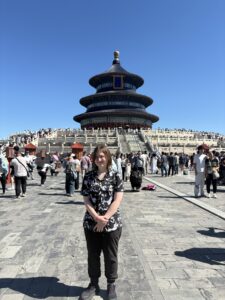
TBC was recently visited by Ignacy from Poland, a third-year student of Comparative Civilization Studies in the Philosophy Department at Jagiellonian University, currently at Peking University.

While he spent time in our very own Anton Library, we asked Ignacy, what brought him to China? He said it was traditional architecture, particularly that of the Forbidden City, which he found the most aesthetically appealing monument in all of Asia. For him, the golden roof tiles dragon motifs, and meticulously painted beams represent the essence of Chinese culture. Additionally, he said he chose China over Japan in Korea, given in his homeland it’s still less explored, at least in the popular media.

How did Ignacy’s journey to Beijing begin? Encouraged by his Chinese teacher, Ignacy entered the Hànyǔ Qiáo (Chinese Bridge) competition, despite not being initially enthusiastic. Understanding the cultural value of China, he pushed himself to prepare, even with little guidance. The online competition, held during COVID-19, challenged participants with questions on language, history, ethnic minorities, and the lunar calendar. His hard work paid off — he performed well and earned a scholarship for an exchange semester at Peking University. Before that, his first visit to China was in summer 2023, when he joined a two-week language camp in Beijing. Reflecting on the competition, Ignacy stresses the importance of advanced Chinese skills and a strong grasp of culture, advising future participants to study ethnic groups, major festivals, historical landmarks, and literature. He credits his tutor’s teaching style — focused on expanding vocabulary and practical use rather than rote memorization — for his success and now encourages Chinese learners to explore beyond the classroom.

Beyond academics, Ignacy also immersed himself in China’s spiritual traditions. Once in Beijing, Ignacy took the opportunity to explore the cultural nuances of China. One area that fascinates him is Buddhism, especially the rituals performed by Tibetan Buddhist lamas in Beijing. He learned about an elaborate ritual called 打鬼 (dǎ guǐ), or “hitting the ghost” — an exorcist ceremony believed to drive away bad luck. Though he couldn’t recall the exact time it was performed, he noted its striking use of masks, embroidered clothing, and real human bone ornaments, which reflect the profound ritualistic nature of Tibetan traditions.

Though the journey hasn’t been without its challenges, he considers it one of the best experiences of his life. It allowed him to access and learn about Chinese folklore in ways that would be impossible back home. His areas of interest go beyond major temples and ceremonies to smaller, everyday expressions of Chinese folk culture. He shared an anecdote about a particular situation at his home university. He tried to raise a small amount of money to buy Fujian puppets (for cultural events), but he received no replies. His interest in Chinese puppet theater was sparked by a respected PhD teacher at his university who had spent four years in China and spoke passionately about Zhangzhou marionettes. When Ignacy came to China, he initially wondered why people preferred shopping on Taobao rather than in stores. But there, he discovered the puppets and other items tied to Chinese folk religion and deities.

Ignacy is greatly interested in Daoism as well as so called “Chinese folk religion” 民間信仰 mǐnjiān xìnyǎng drawn by their rituals, magical world of gods and immortals, and rich imagery. He considers Daoism the spiritual core of Chinese culture and has read several books on the topic during his stay. One book helped him understand how Chinese temples and popular cults operate, reinforcing his view that Daoism reflects Chinese intellectual and spiritual history. In his view, supernatural themes in traditional theater and literature are almost always Daoist in origin or influence. He has visited all major Daoist temples in Beijing, as well as temples in Ningbo and Pingyao such as the City God Temple, Temple of Wealth, and temples dedicated to the Fire God, Emperor Yao, Martial Temple. City God temple in Ningbo, and Beijing’s Temple of the Eastern Peak are by far his favorites. He also holds a deep impression of the Lama Temple in Beijing, a Ayuwang Buddhist temple temple in Ningbo, and the Confucius Temple in Qufu.

With only 20 days left in China at the time of this interview, his goals included finishing several books from the TBC Anton Library and Peking University Library, visiting the Bell and Drum Tower, walking along Beijing’s symmetrical central axis, and returning to the Lama Temple one last time. At TBC, he read four books, including Modern Religious Trends in China, which described the transition period from 1911 to 1949. He was especially struck by the near disappearance of ancestor worship in the 20th century — a tradition he greatly admires. Coming from a Catholic background, he found it comforting that in Chinese culture, one prays to family ancestors who are believed to have a role in the spiritual world — closer, more personal. Initially skeptical of Matteo Ricci’s missionary work in China, he changed his mind after learning that Ricci had mastered classical Chinese, composed poems from memory, and engaged deeply with Chinese scholars and monks. His respect for Ricci grew as he realized how immersed and respectful Ricci had been of Chinese traditions. What particularly surprised him, was the fact the Ricci and Tang Xianzu (author of “Peony Pavilion” – one of China’s most famous love stories) knew each other in person, and that the encounter with the Italian visitor may have influenced his works.

Ignacy has clearly demonstrated an impressive level of proficiency and passion for Chinese history, culture, and folklore. If we were to grade him, it would surely be an A+! TBC is honored to have welcomed such a curious and dedicated young scholar into our library — a perfect fit for the largest English-language collection about China.

By Laury Castro, TBC Intern

More To Explore

Student Footprints

YES Student in Hong Kong

Over spring break, I was given the opportunity by TBC to take a scholarship-supported trip to Macau, and from there, enjoyed just over three days in Hong Kong. Lamma Island, a small island in Hong Kong, is where most of my mom’s China stories take place.

Cultural Dialogues

Thomas Michael: Nature as a Guidepost to Begin the Study of Daoism 

Recently, Thomas Michael, a professor at The Beijing Center (TBC), was interviewed our staff and shared with us his perspective on studying Daoist thought and living in China. Professor Michael is a researcher at the School of Philosophy at Beijing Normal University.