跳到主要内容

The Beijing Center

the beijing center for chinese studies

Ceramics

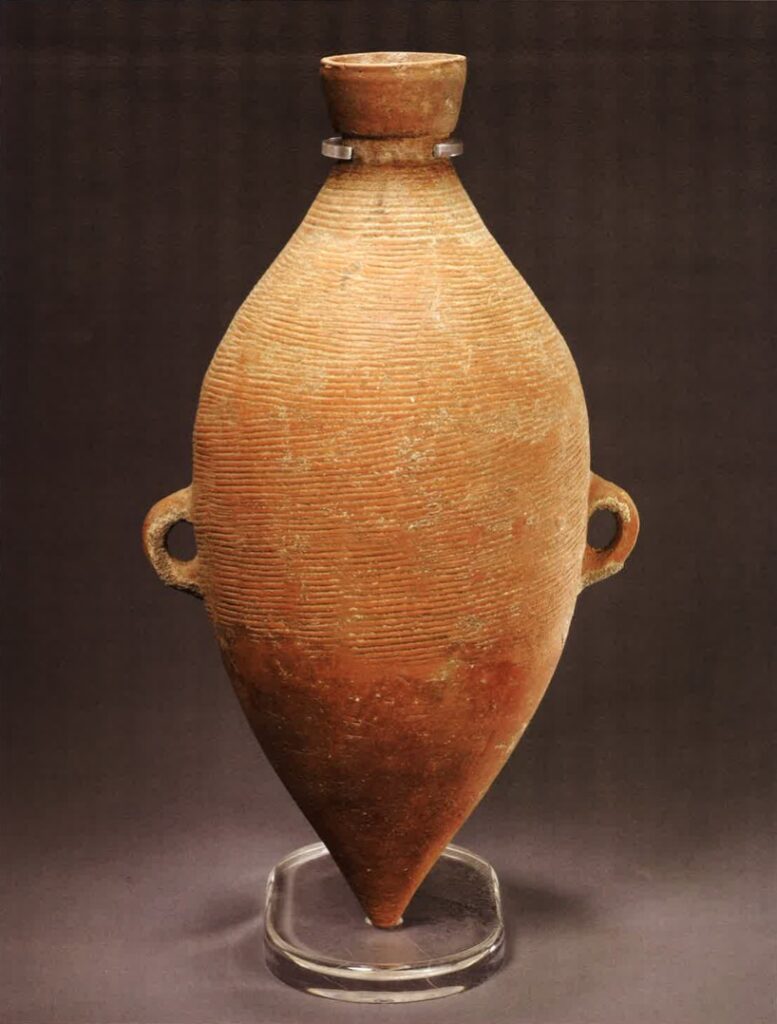
Amphora with loop handles

information

Yangshao culture, Banpo type (4800–4300 BCE)
Central Yellow River Valley in Shaanxi province, near present-day Xi’an
Height: 44.5cm Diameter: 24cm
**Oxford Authentication Laboratories thermoluminescence tested, sample no. C2106s91

introduction

This piece is made from red pottery shaped into an elongated form with a pointed base. Its long neck ends in a cup-shaped mouth. The body is textured with rope marks two-thirds of the way down. Used for collecting water, the shape of this vessel is ideally suited for that purpose: the amphora would have been held on a piece of string tied to both handles and then tossed onto the body of water, where it would gradually tilt upright as it filled, allowing for easy removal and carrying. The almond-shaped body, cup-shaped mouth, and textured body mark it as a typical Banpo piece.

Co-evolving regional Neolithic cultures existed in this early period, most of which produced ceramics. Different ceramic ‘types’ are indicative of different ‘phases’ of development among the regional cultures. Yangshao culture covers the period of 5th and 4th millennia BCE, and the area from Gansu to Hebei. The ceramics of the Neolithic Yangshao culture of China’s central plains region is typified by those produced at the village of Banpo near Xi’an. One of the most notable styles produced by Banpo are textured amphorae with pointed bottoms similar to this one. The kilns unearthed at Banpo reveal relatively advanced kiln-making technology (throughdraft and updraft kilns) with separate fireboxes for fuel away from the firing chamber, separated by flues. Banpo is arguably the most famous Neolithic site in China, typifying the phase flourishing between 4800 and 4300 BCE.
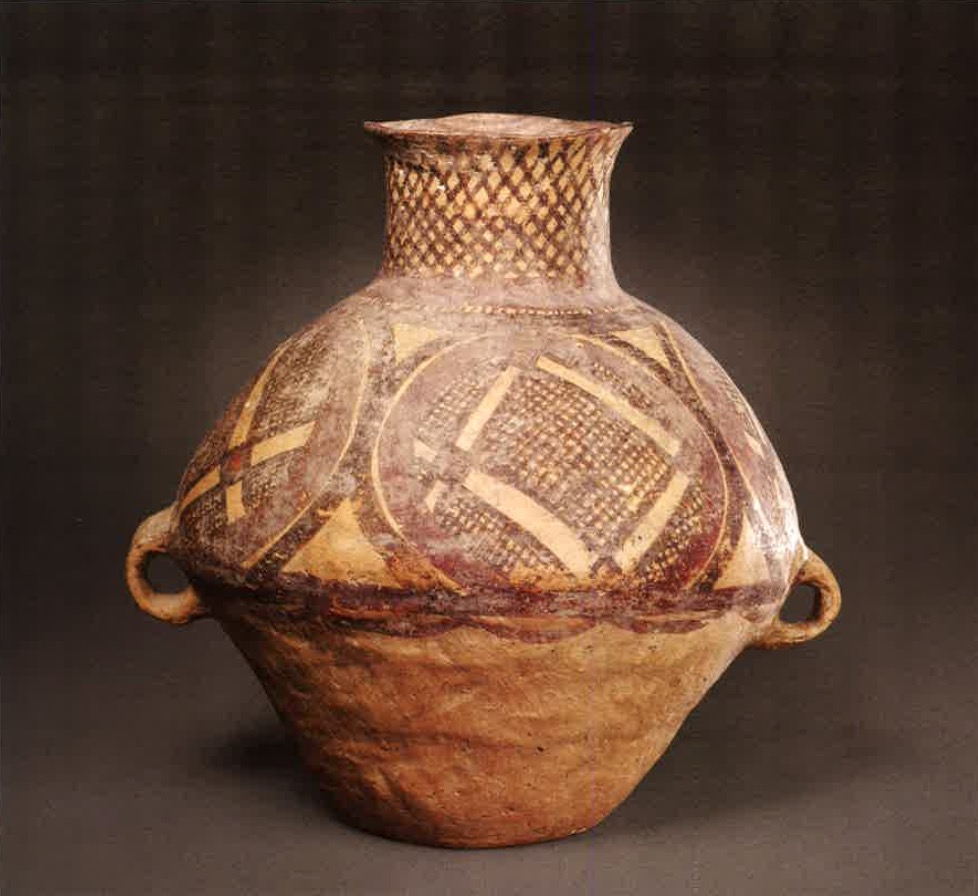
Painted jar with double handles

information

Majiayao culture, Banshan type (2600–2300 BCE)
Gansu or Qinghai province
Height: 25cm Diameter: 22cm

introduction

The designs on this earthenware jar are painted with black and red pigments in the bands of bold designs characteristic of Banshan type pottery. This jar is painted with a pattern of tightly cross-hatched large diamonds framed within circles. The neck is ringed with a wide band and painted with a net pattern, while the interior lip is painted with overlapping groups of three gently curved concentric lines. The smooth pottery on the outside belies the fact that the jar was created using the coil method: instead of being thrown on a potter’s wheel, it was formed of many clay coils stacked together and then smoothed out by hand.

There are regional variations in the phases of the Yangshao culture, one of the most notable being the pottery produced in Banshan. These wares are large, thin-walled, ovoid jars with a variety of geometric designs painted in red and black pigments, and are considered archetypal Neolithic Chinese pots. A jar such as this typifies not only the style but also the high level of technique which had already been attained by this point in the development of ceramics production.

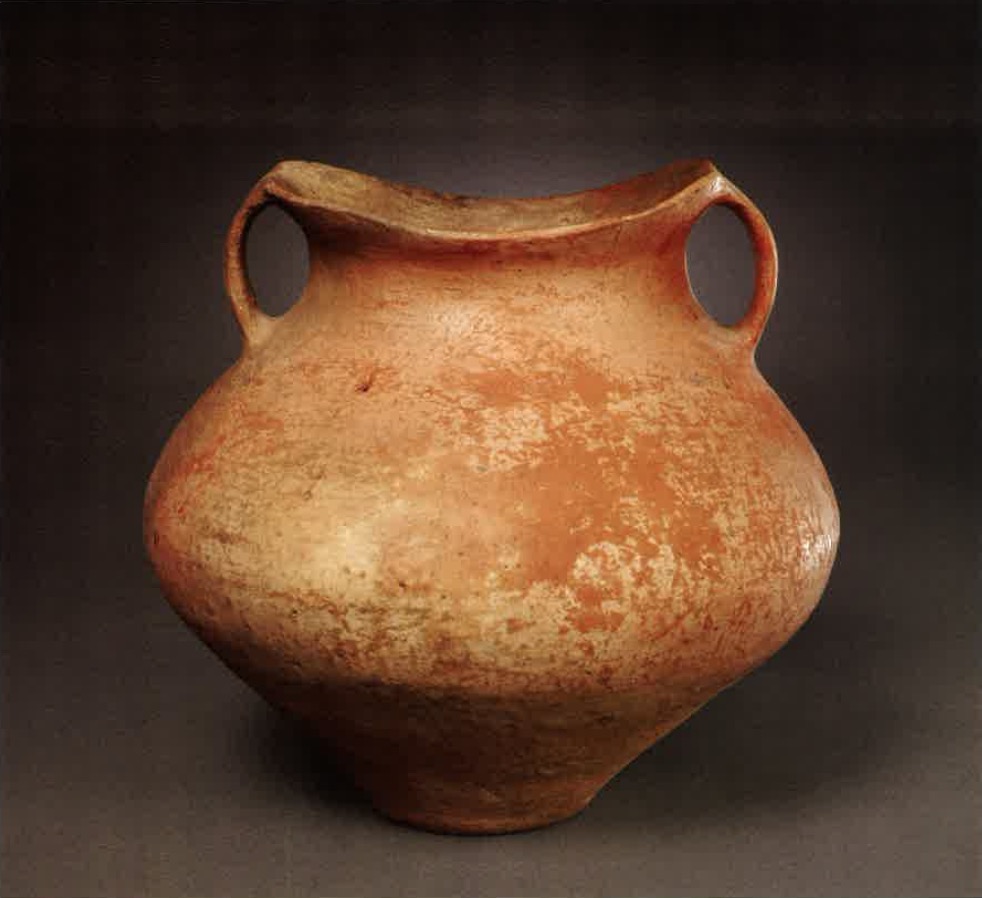
Red pottery jar with boat-shaped mouth

information

Siwa culture, mid-late second millennium BCE
Upper Yellow River Valley/Gansu province
Height: 17cm Diameter: 17cm

introduction

The gracefully plump silhouette of this jar is emphasized by its flared neck cut into a boat-shaped mouth. The overall shape of the recessed base and bulging middle is balanced by the placement of its two small handles at the neck. Its simple red earthenware is hand-potted, rather than thrown on a wheel, and neatly burnished. With the beginning of the Bronze Age overlapping with the end of the Neolithic period during the second millennium BCE, pottery production began to decline, and painted decoration nearly disappeared altogether. The Siwa culture in particular is known among the Neolithic Chinese cultures for plain two-handled jars with boat-shaped mouths.

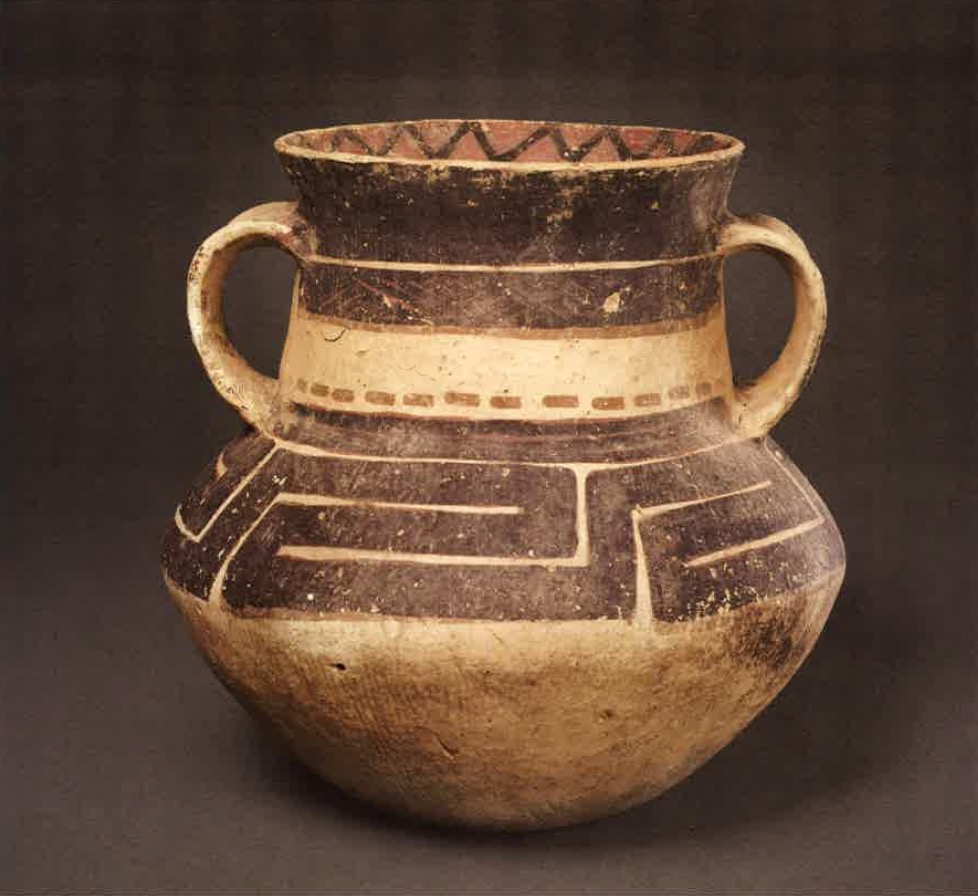
Painted jar with key-fret pattern

information

Xindian culture (c. 1000 BCE)
Gansu province
Height: 18cm Diameter: 18cm

introduction

The Xindian culture is one of the rare Late Neolithic cultures which produced mostly painted ceramics, here using the three colors red, brown, and black. The two loop handles on the waisted neck are painted with extensions of the key-fret/thunder spiral design on the shoulder of the jar. The waist is emphasized by a band of brown dashed lines, a band of unpainted space, a band of closely-spaced black and red diagonal lines, and a solid black line. The interior lip is painted with a black zigzag pattern on a wide red stripe. Although it does not have the curvilinear “yoke” pattern characteristic of Xindian pottery, its wide key-fret band of decoration is seen often on Xindian jars of this typical form.

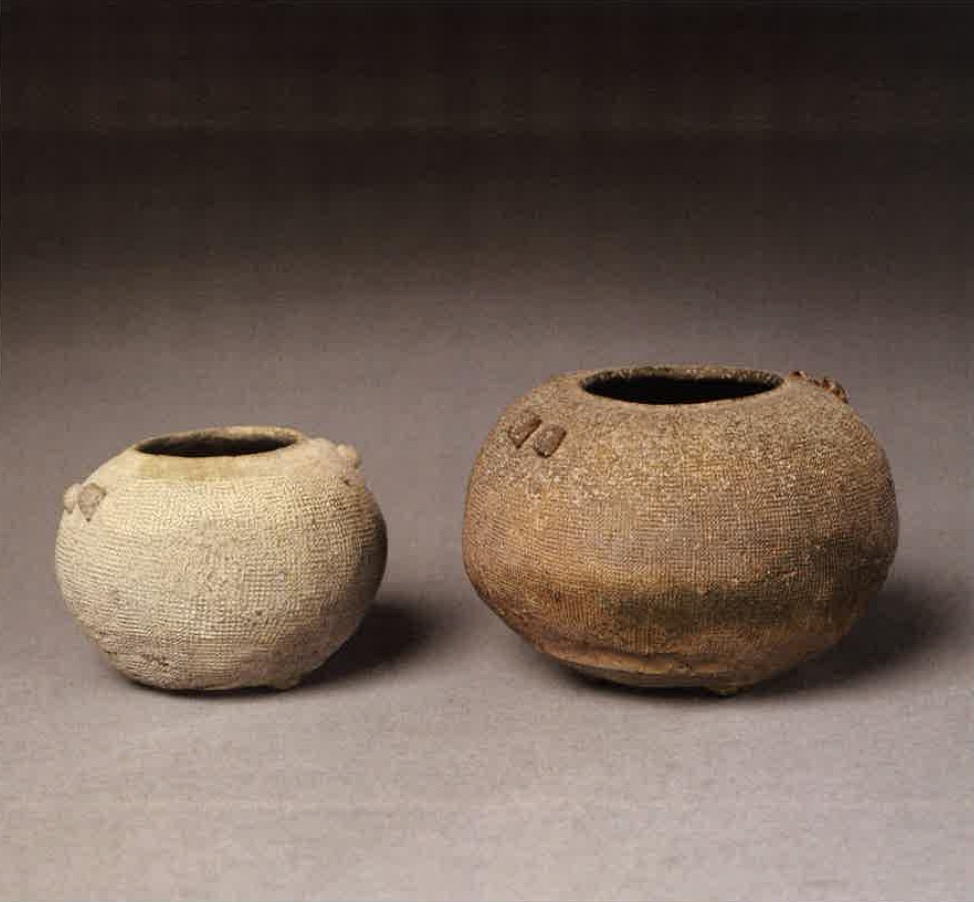
Two small impressed fabric-pattern grey pottery vessels

information

Warring States period (475–221 BCE)
Zhejiang province
Height: 3cm Diameter: 4cm; Height: 3.5 cm Diameter: 5cm

introduction

These two miniature vessels are skillfully potted of a fine, thin-walled grey earthenware, patterned with an impression of finely-woven textiles on the bodies. The vessels themselves are shaped into somewhat flattened rounds with neatly-trimmed mouthrims. Small-sized vessels such as these are very rare and speak to the potter’s skill, because these tiny, delicate pieces still reflect the typical Warring States ceramics characteristics of impressed pattern and grey body.

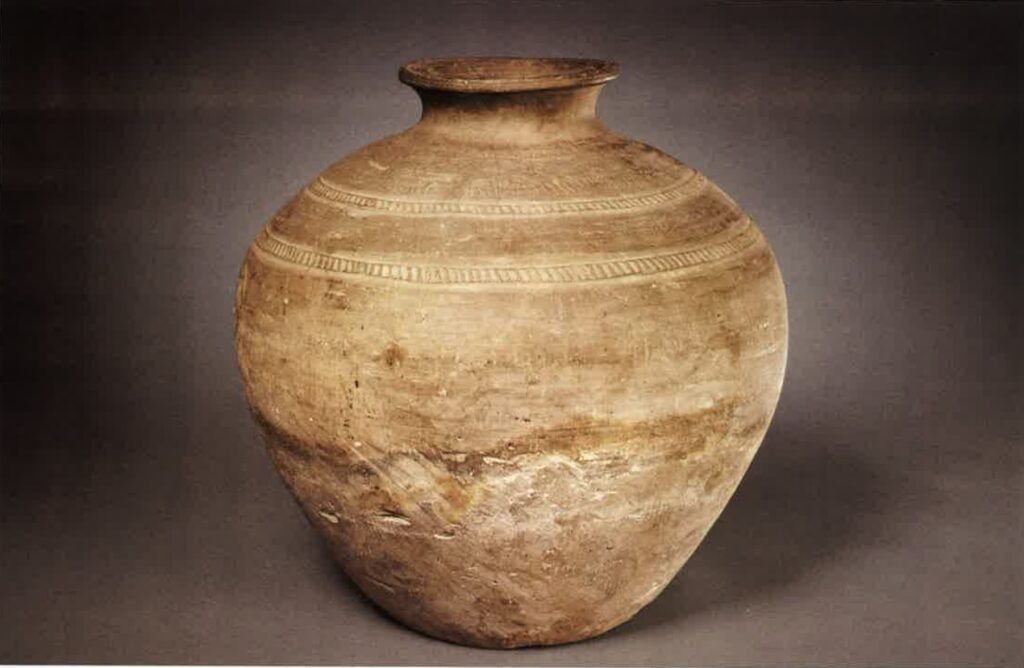
Double- ribbon jar

information

Han dynasty (206 BCE–220 CE)
Height: 19cm Diameter: 26.5cm

introduction

This wheel-thrown round jar is made of high-fired, unglazed grey pottery. The simple piece has a round neck and a flared mouth, and its only ornamentation are the two ribbons of impressed decoration on the shoulder of the jar. One style of jar frequently seen during the Han period has the decoration limited to the upper portion of the body, above the widest part of the pot as seen on this vessel. Although glaze development had already begun, in the Han dynasty, simple everyday pottery often followed the traditions of the Zhou and Warring States periods. Namely, that pots were sturdy and practical, and decorated with simple, geometric incised or impressed patterns rather than glazes.

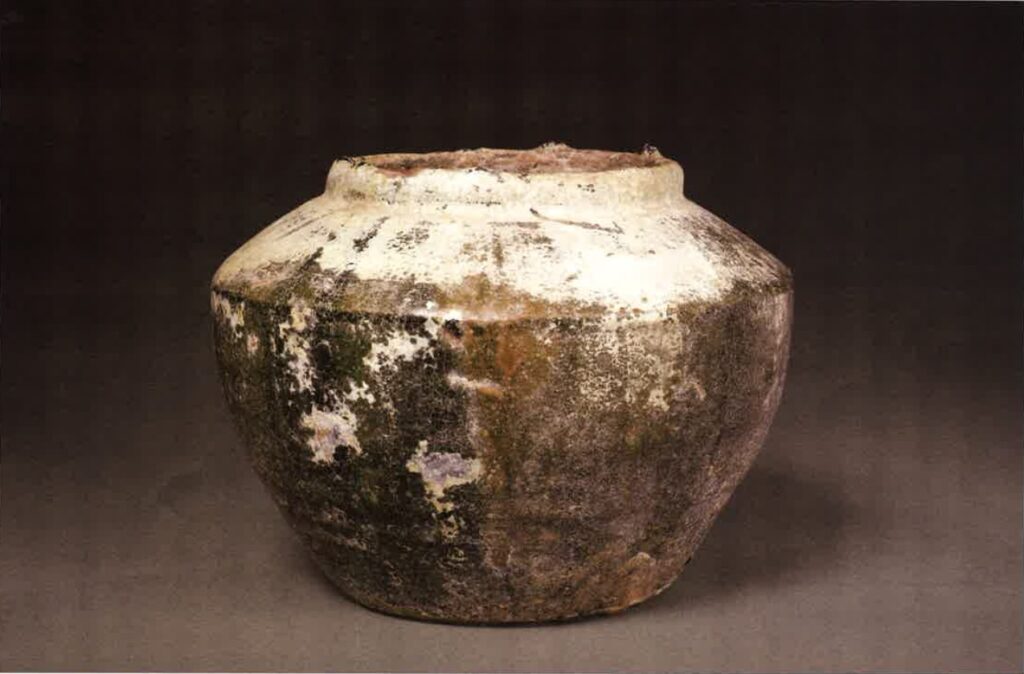
Green-glazed jar

information

Western Han dynasty (206 BCE–9 CE)
Height: 12cm Width: 18cm Mouth diameter: 9cm

introduction

This small jar is covered with a mottled green glaze which ranges in tone from nearly-black to a ruddy olive. Jars such as this are characterized during the Han period by a wide mouth, short neck, deep, globular body, and flat base or footing, regardless of their overall size. The use of lead glaze here – glazes in which lead oxide is added as the principal fluxing agent – allowed the unbaked vessel to be fired to a higher hardness at a lower temperature than otherwise required for high-fired wares. Although archaeologists have discovered glazed wares dating back as early as the Shang dynasty, the Han dynasty marks the first time glazes were frequently used.

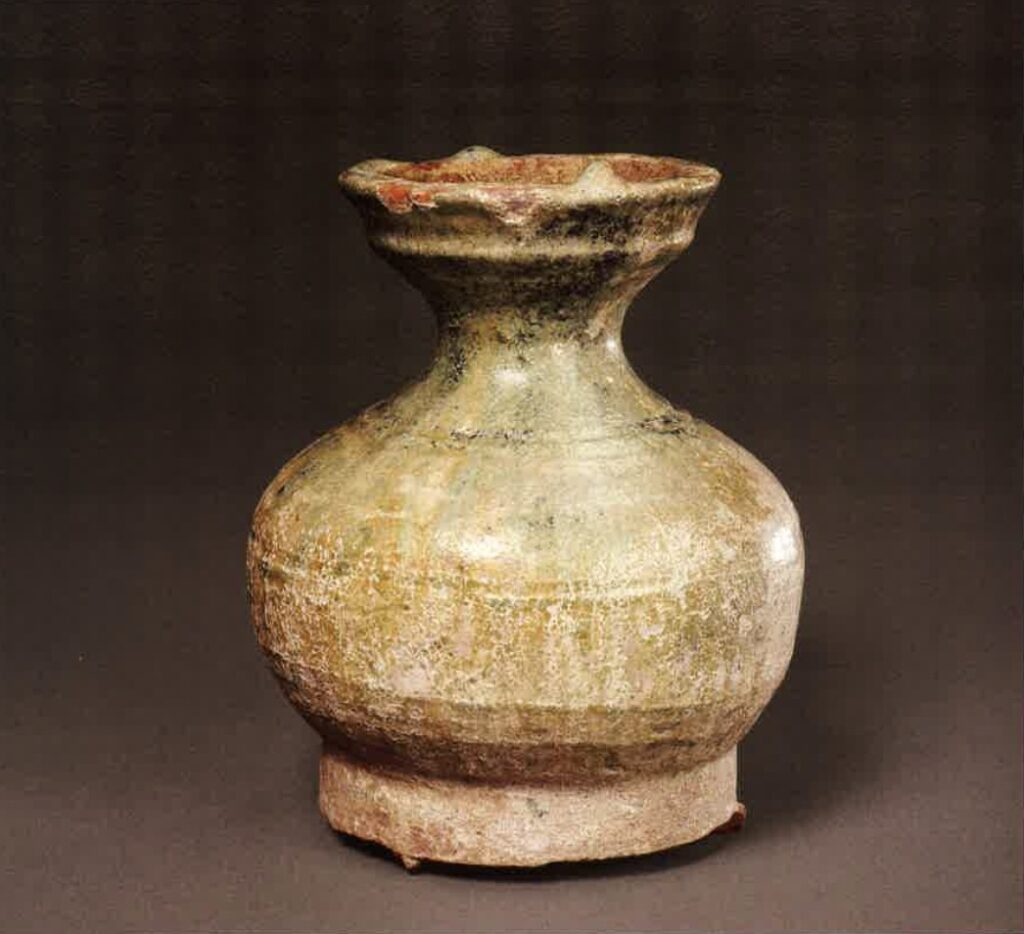
Green-glazed hu pottery jar

information

Han dynasty (206 BCE–220 CE)
Shaanxi province
Height 14cm Diameter: 11cm

introduction

This small jar is covered with a lead glaze that oxidized during firing into a mottled green ranging from seafoam to deep pine with a silvery overtone. The interior of the mouth is glazed with a yellow-brown glaze, and the red earthenware is visible deeper inside the interior. The base of the jar was also glazed. Hu-type vessels are characterized by a noticeable footing, a wider body, a narrow neck, and a flared mouth. Such jars often serve as vases, spittoons, jars, and teapots.

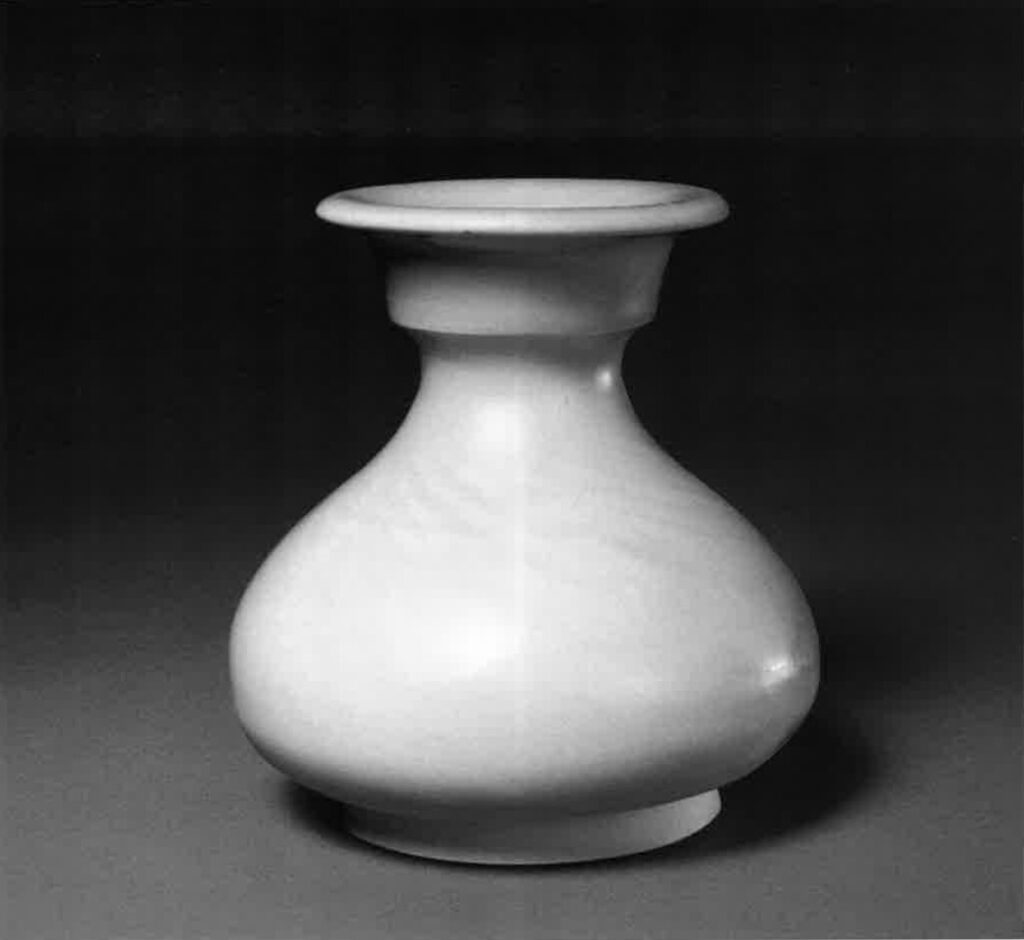
White-glazed refuse vase with dish-shaped mouth

information

Tang dynasty (618–907)
Height: 15cm Diameter: 13cm
**Oxford Authentication Laboratories thermoluminescence tested, sample no. P106c62

introduction

This simple vessel is cleanly potted with a flared lip and flattened globular body, lending a elegant silhouette to its likely use as a spittoon. This piece is made especially elegant because of the subtlety of the silhouette, because Tang-period spittoons often had a much wider, bolder, funnel-shaped mouth which made them easier to use. The vase is evenly covered with a white glaze subtly tinted with pale green. The glaze ends abruptly in a crisp line just out of sight below the vessel’s widest point and above the footring. The evenness and control of the glaze application as well as the sharp neatness with which the footring is cut is indicative of the high level of skill and technique attained by the Tang dynasty potters.

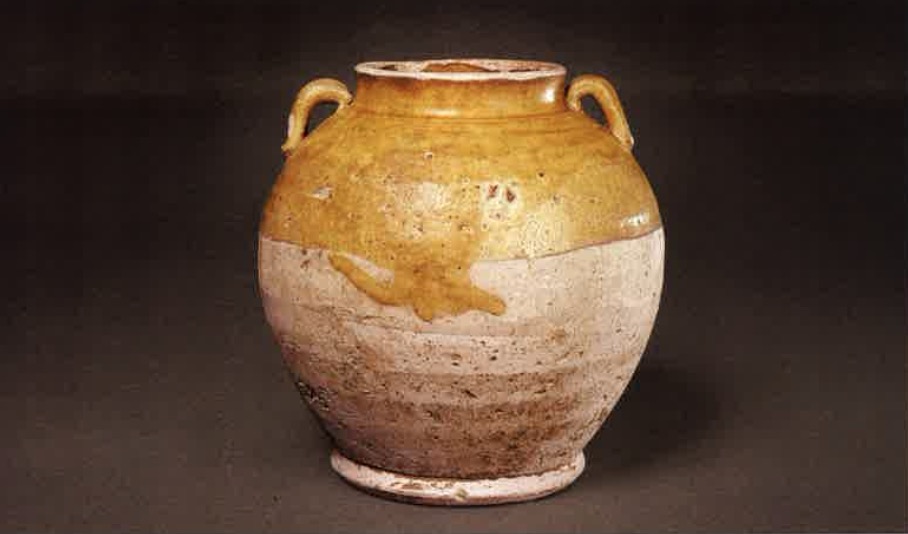
Yellow-glazed jar with double handles

information

Tang dynasty (618–907)
Height: 16 cm Diameter: 16cm

introduction

This jar is cleanly potted with a flat base and short, straight neck. It has two double-loop handles, evenly placed on either side of the mouth. It is partially glazed with a pale yellow glaze fired into tiny crackles. Yellowware was one of the main types of wares produced during the Tang at the Yaozhou kiln centered in Shaanxi province, a kiln which later became famous during the Northern Song dynasty for its production of celadon-glazed wares. The handles are too frail to have been functional, serving rather to lighten the silhouette of the jar, or perhaps to hold a cord tied around the neck of the vessel. The unglazed lower portion of the jar, its double-loop handles, and sturdy form are all Tang dynasty characteristics.

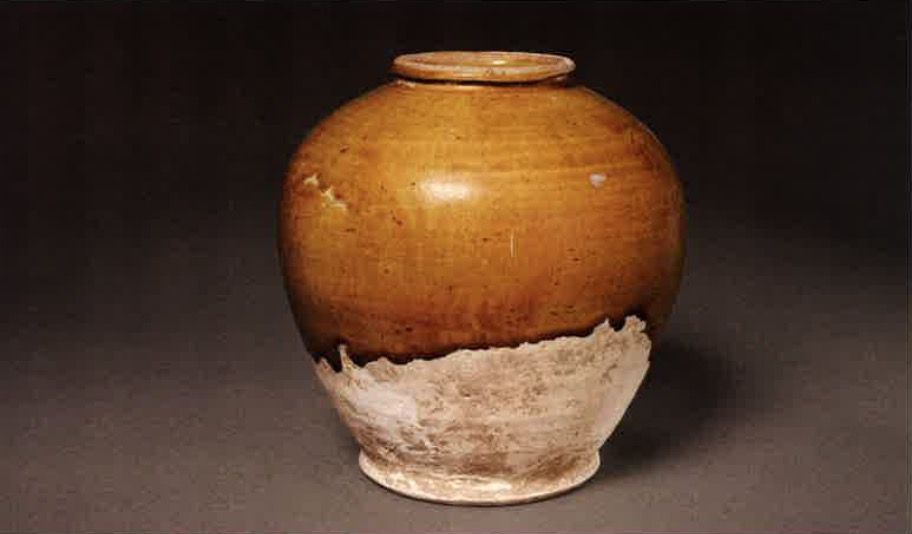
Ochre-glazed jar

information

Liao dynasty (916–1125)
Height: 14.5 cm Diameter: 14.5 cm

introduction

This simple jar has a folded lip and a small mouth with no superfluous added features. It is partially glazed with a ochre-colored glaze fired into small crackles, while the color deepens into a concentrated, caramel-like color where the glaze drops thickened at their lowest points on the body of the vessel. Interestingly, the interior of the vessel is fully glazed, leading to the assumption that the potter’s decision to glaze the exterior only partially was made for aesthetic reasons. Ethnically, the Liao dynasty was not Chinese, but were rather Qidan (Khitan) nomads. However, while many questions about their ceramic production still exist, Liao ceramics make a conscious effort to imitate their Chinese predecessors in the use of monochrome-glazed wares in shades of green, brown and yellow, like those seen during the preceding Tang period.

Dark brown wine jar with spout and handle

information

Ming dynasty (1368–1644)
Shaanxi province
Height: 19.5 cm Diameter: 21 cm

introduction

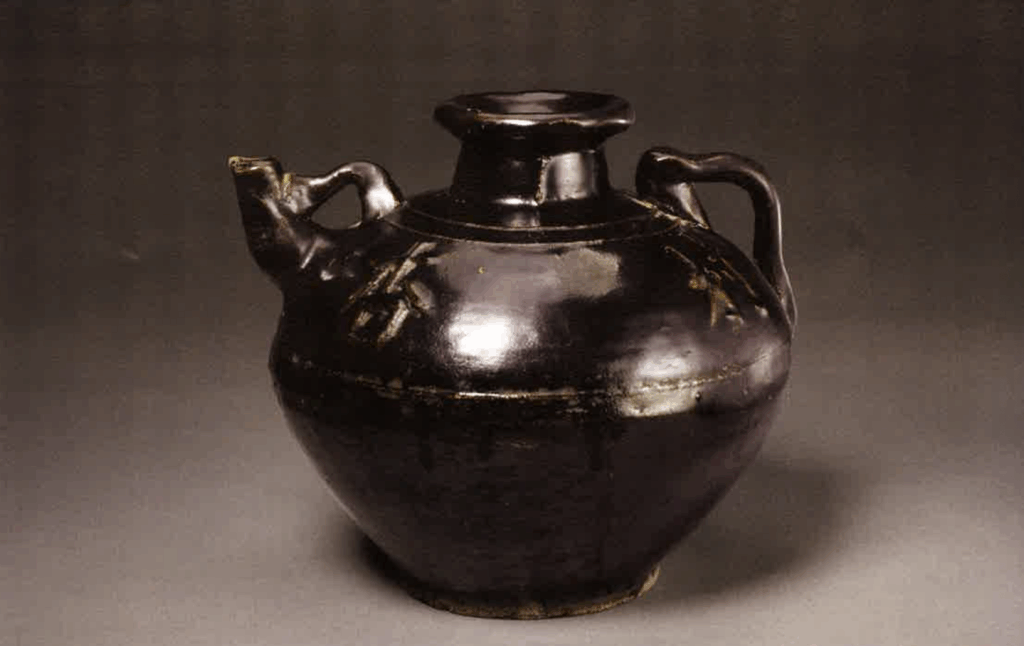
This dark-glazed piece was built in sections. The bottom half was thrown on a wheel, and the top half is built of four slabs pressed in a mold carved with characters. The four slabs were then attached to the base and to each other, followed by the addition of the neck, spout and handle. The seams of the piece indicate its construction, although the placement of the spout and handle on two of the seams draw attention away from these joints. The four characters xinghua cunzhuang (meaning “Apricot Blossom Village”) are spaced around the sides of the upper half of the jar. Their presence on a wine jar such as this likely refers to the famous “apricot blossom sorghum wine” (xinghuacun fenjiu), a famous strong spirit that has been brewed in Shaanxi province’s Fenyang county since the 5th century.

Wide-mouthed jar

information

Possibly 15th century – late Ming/early Qing dynasty
Height: 16cm Diameter: 21cm Mouth diameter: 9cm

introduction

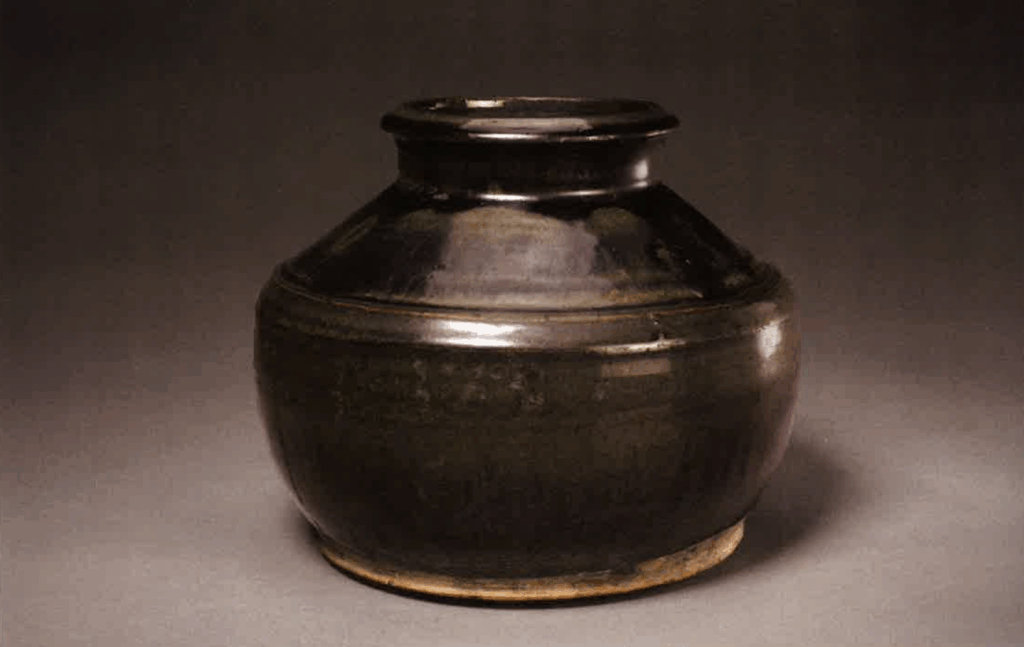
This vessel is notable for its wide mouth, which emphasizes the flattened ring around the shoulder of the piece. The slightly-flared lip and short neck give way to a straight, sharply-angled shoulder before softening into the rounded bottom half of the piece. The mottled blue glaze thins over the ridges to show the buff-colored biscuit, its deep orange hue contrasting nicely with the green and indigo tones of the glaze. The vessel is glazed inside and out, and the glaze itself has a very slight iridescent shine.

Flambé-glazed meiping

information

Qing dynasty (1644–1911)
Height: 18.5 cm

introduction

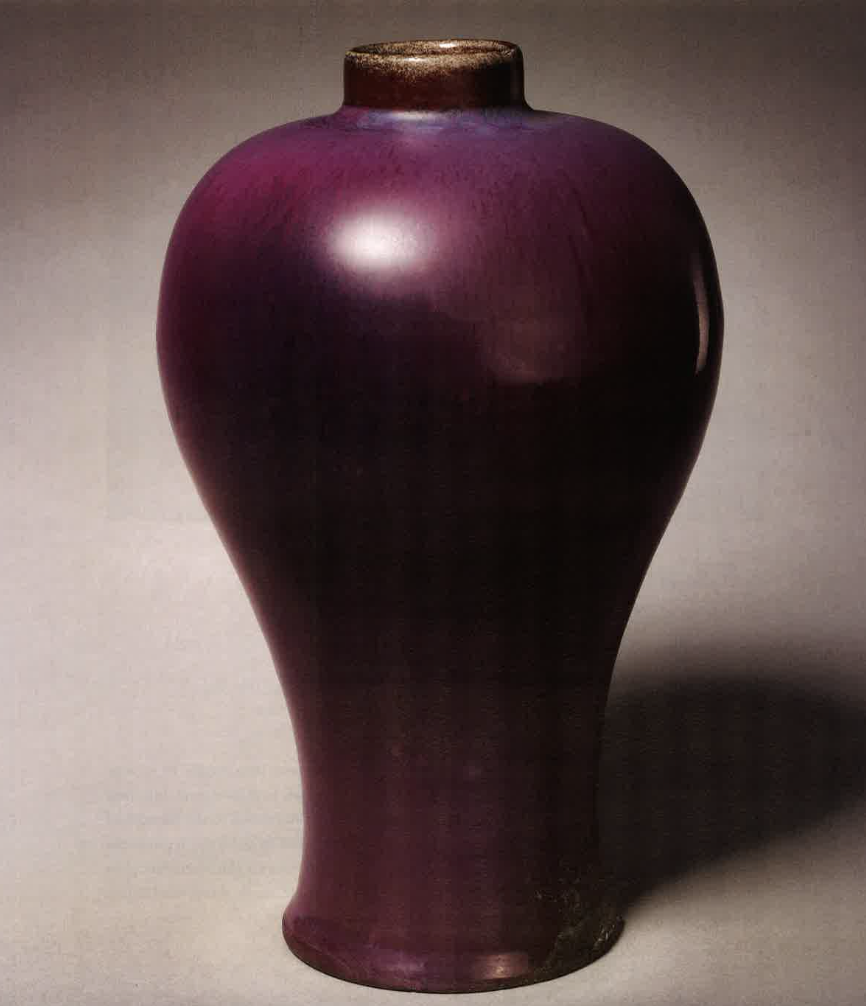
This meiping vase is glazed with a flambé glaze in subtly-integrated hues of red, fuschia, lilac, deep violet, and sky blue. The glaze was allowed to run down the body in streaks during the firing, which creates the downward-streaking effect, and the various colors were produced naturally during the course of the firing. The meiping shape is characterized by a small mouth, a wide rounded shoulder, and narrow foot. This particular vessel’s foot gently flares out again at the bottom, lending it an especially voluptuous appearance. The term meiping literally translates as “plum vase.” Originally, during the Song dynasty, this form was used for wine jars, but it later became a flower vase, the small mouth just large enough to hold a spray of plum blossoms.

Flambé glazes. also called transmutation glazes, originally referred to any unexpected color which appeared in the glaze after firing. The original transmutation glazes are found on the jun wares of the Song dynasty (960–1279), mixing shades of red, purple, blue and green together in unique ways. Transmutation glazes became popular again during the reigns of the 18th-century emperors Kangxi, Yongzheng and Qianlong. This imperial taste for archaism meant that not only were ancient forms revived, but also ancient glazes, including transmutation glazes. These wares could be modeled directly on Song originals, and were sometimes intended to be passed off as antique originals. Such copying of classic types was a Qing tradition, and still continues in contemporary China.

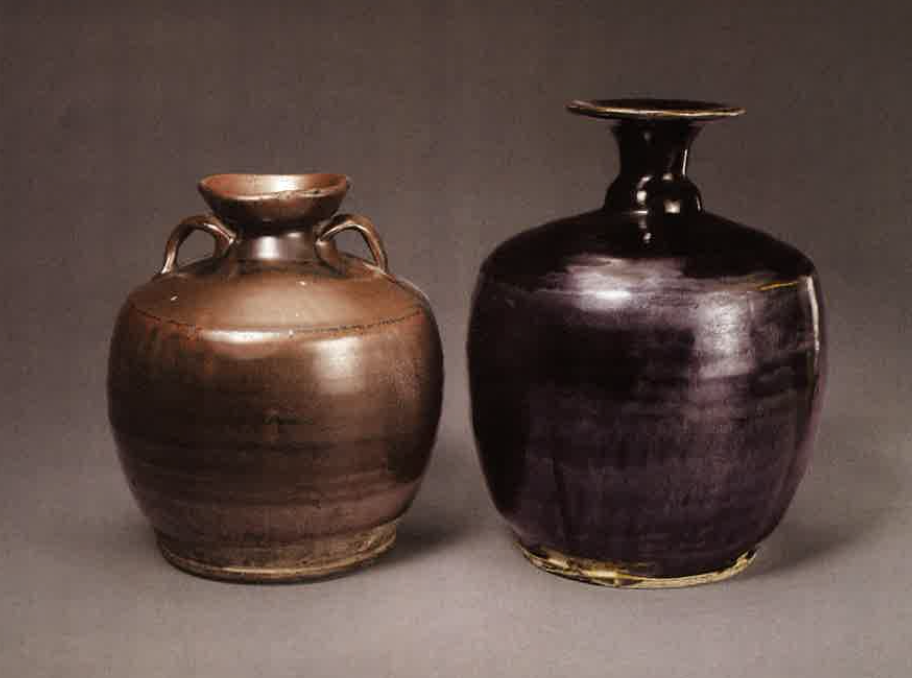
Double-handled jar with brown iridescent glaze Wide-lipped jar with black iridescent glaze

information

c. mid‑late Qing
Height: 19.5cm
Diameter: 18cm

c. 1915
Height: 23cm
Diameter: 19cm

introduction

Both of these jars are similarly shaped with wide‑lipped mouths, visible necks, high shoulders, and gently‑curved bodies. The glaze on both pieces ends above the foot so that the unglazed ware underneath is visible: coarse buff pottery for the shorter vessel and finer white pottery for the taller vessel. The shorter jar has handles connected at the neck and shoulders, and is rather thickly potted with an uneven lip. Its brown glaze darkens to black at the neck, inside the lip, and where it ran below one handle, but has an all‑over iridescent sheen which gives a coppery tone to the glaze. The taller jar is more finely potted, with a delicately curved and flared lip. Its black glaze has an even more pronounced iridescent sheen in shades of blue, violet and silver, which lends elegance to such a simple piece. There are a number of characters written on the bottom of this vessel, but most are obscured. However, the clearest character is rong, which literally means a fig or banyan tree, but also refers to the southern city of Fuzhou, the capital of Fujian province. It is therefore possible that this piece originated from Fuzhou.

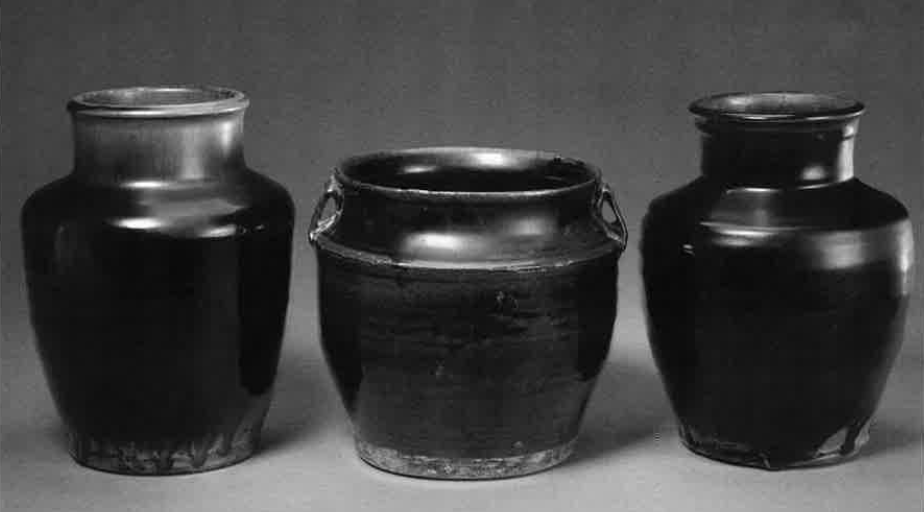
Tall jar with long neck Double-handled jar with wide mouth Black-glazed jar

information

Late Qing (c. 19th century)Late Qing (c. 19th century)Mid Qing (c. 18th century)
Height: 20cmHeight: 17cmHeight: 20cm
Mouth diameter: 9cmMouth diameter: 15cmMouth diameter: 8cm

introduction

These three dark-glazed jars are all roughly contemporaneous. The center jar is marked by its wide mouth, sharply everted shoulder and double handles. The two other jars both have glaze drips near the bases, and are of similar form, with tall necks, fairly wide mouths in relation to the diameter of the vessels, and squarish shoulders. These two jars are each distinguished by particular features: the incised ridges on the neck of the jar on the right, and subtle body iridescence plus the lighter glaze transmutations on the neck of the jar on the left. All three of these simple, sturdy vessels would likely have been put to daily use.

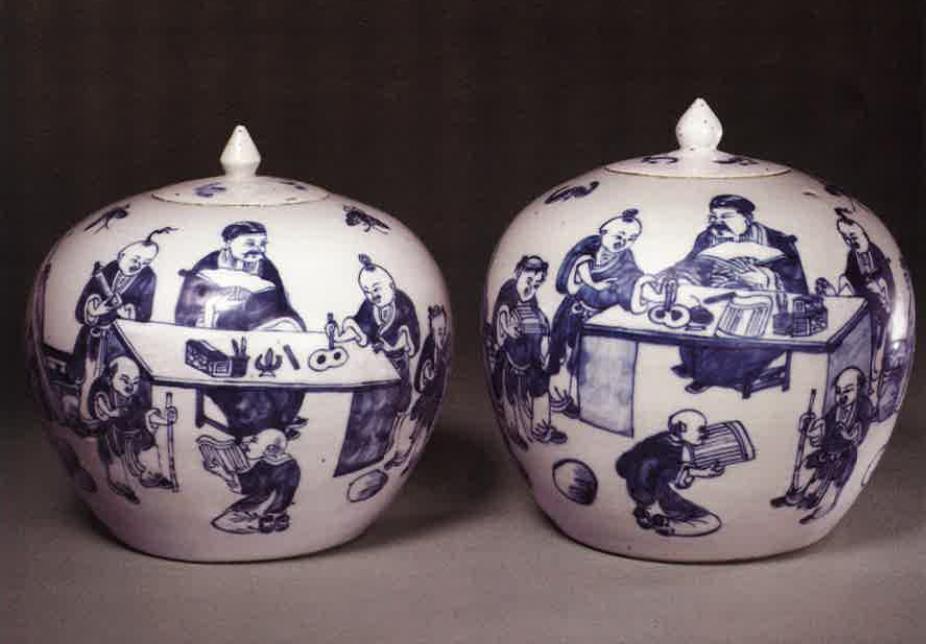
Round jars with scholar scene

information

Qing dynasty, smaller jar c. Tongzhi period (1862–1874); larger jar likely later
Height not including lid: 18cm (left), 20cm (right) Diameter: 21.5cm

introduction

Both of these jars are painted with a scene of a scholar and pupils in underglaze blue. The scenes are near-mirror images of each other, with only a few small discrepancies, such as the additional objects on the scholar’s table and the substitution of a butterfly for a bat on the larger jar. Both scenes show a whiskered scholar seated at a large table with a fan in his hand. On the table sit a few traditional scholars objects, such as a brush pot with brushes, brush rest, inkstone, and scroll boxes. The scholar watches one of the young men grind ink while others look on. A young man carrying a book stands next to the ink grinder. To the left of a the scholar stands a young man carrying a scroll, and in front of him is a small child with a stick. In front of the table a child kneels, reading a book. The entire scene is set in a garden amidst rocks, while butterflies (and a lone bat, ostensible a rebus for good luck) flutter overhead.

Aside from the discrepancies in content on the jars, there is also a difference in the painting quality between the two vessels. The smaller jar is finely painted with careful attention to detail, while the larger jar is more relaxed in its portrayal of the scholar and his students. This difference likely indicates that the second jar was made later, possibly in the 20th century, but specifically as a companion to the first jar.

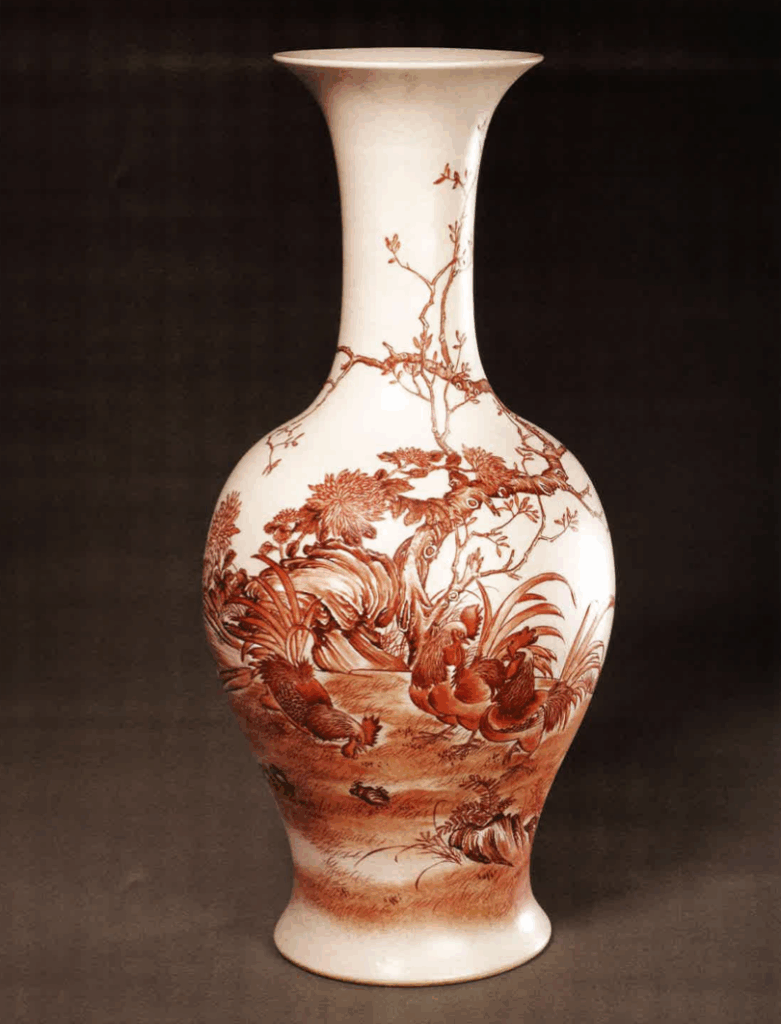
Double-fired Triple Rooster Vase

information

Qing dynasty, Guangxu period (1875–1908),
Guangxu reign mark and of the period
Height: 40cm

introduction

The scene on this vase depicts three roosters on a grassy ground in front of rocks, chrysanthemums, and a gnarled tree coming into bloom. The tree, flowers, rocks and birds are all molded in low relief, which gives them both depth and texture. The scene is carefully depicted in tones of coral red, with attention to detail and a painterly application of the varying tones to suggest additional texture, especially on the rocks. Most of the scene on the vase is underglaze painted, although delicate details – such as the detailed body feathers of the three birds – are overglaze painted and therefore palpable. The vase was therefore fired twice, once after the first layer of color and its transparent glaze overlayer were added, and then again after the second layer.

The symbol of the rooster embodies the Chinese concept of yang, meaning warmth, masculinity, and life of the universe. The rooster traditionally has five particular attributes: his crown is a mark of literary spirit; his spurs indicate his warlike disposition; his willingness to take on enemies belies his courage; his clucking for his hens upon finding grain shows his generosity; and his daily crowing at dawn indicates his faithfulness. With qualities such as these ascribed to the rooster, it is only fitting that they be included on this vase. The vessel was a gift from the Emperor Guangxu to General Cen Yuying’s battalion for the successful repression of an 18-year rebellion in Dali, Yunnan province, which ended in 1873. The vase was then given to General Mu Yulin, a native of Lijiang, for his military exploits in the battle. The vase was purchased from General Mu’s family and donated to TBC by Mr. Xu Jinhao of Kunming, Yunnan.