The Beijing Center

THE KING OF ALL SWEET TREATS

Share This Post

China is well known for its diversity of food dishes. This diversity leads to many local dishes based off of provinces in China, which may taste exotic to many foreigners. My all-time favorite Chinese dessert/snack is the famous 蛋挞 dàntà.

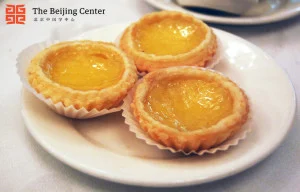
What is a dàntà exactly? Dàntà is basically an egg tart; it is a tiny pastry that can be devoured in one savory bite. This pastry can be practically found all over Hong Kong and any Asian bakery. These egg tarts are best eaten when fresh out of the oven, where its outer crust is flaky and its inner crust is soft and buttery.

There are two versions of the egg tart. The Portuguese egg tarts have a caramelized top and a less egg-like taste, while the dàntà is a Hong Kong rendition of the Portugese style, where they have more of a sweet egg-like taste (This one is my favorite).

According to the history of egg tarts, it was first found in Guangzhou, China. During the Opium War, European culture quickly impacted and influenced the Chinese market. This led to new kinds of pastries offered all around the markets.

You know you have the perfect dàntà when the crust has a buttery flaky texture and the yellow egg custard is sweet with a hint of caramel.

There are many bakeries outside of West Gate that carry this delicious treat…happy dàntà sampling!

By Chris Kong, Loyola University Maryland, TBC Communications and Social Media Intern and Fall 2015 Student

More To Explore

Global Connections

Gubei: An Excursion to China’s Newest Old Water Town

Over this past weekend, some of our students enrolled at Minzu University of China took their annual Spring Outing – this year, to Gubei Water Town. Situated about a 2-hour drive northeast of Beijing, the April weather made it absolutely perfect to explore for a spring outing. It surrounds various canals and offshoots of Yuanyang lake.

Global Connections

Beijing’s Hutongs: From Snuff Bottles to Exploration with a View

If you ever want to get a taste of Old Beijing, by far one of the best ways is to visit the hutongs. They’ve conceptually been around all the way since the 1200s, and in their most modern forms exist as protected alleyways and streets surrounded by old traditional houses and neighborhoods in the heart of Beijing and are recognized in China to be an important part of cultural heritage in the city.