The Beijing Center

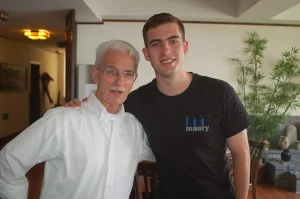
FR. GENE

Share This Post

During the closing ceremony for the spring 2015 semester, TBC’s Dean of Academics and Faculty, Russell Moses, addressed the students for a final time. When thanking certain faculty members, Dean Moses described TBC’s Academic Advisor, Fr. Eugene Geinzer, SJ as “the heart of TBC.” In my opinion, this could not be a more accurate statement.

One of the reasons TBC is such an incredible program is because of how personable and approachable the staff is. No one embodies this more than Fr. Gene. Being a professor and Academic Advisor at TBC, he has plenty of contact with students right when the semester starts. This past semester, he instantly became a favorite.

Every Sunday, Fr. Gene, along with TBC Director, Fr. Jim Caime, would offer mass to the students in their apartments. Coming to China is obviously a huge transition but being able to celebrate the Eucharist every Sunday with friends was extremely comforting. These gatherings became very intimate for those of us that attended regularly. Fr. Gene would also join us for dinner afterwards almost every Sunday. Even though he is about 50 years older than us and a professor, he was one of the easiest people at TBC to become friends with. TBC would not be the same without him.


By Tommy Sullivan, Boston College, TBC Social Media and Communications Intern and Spring 2015 Student

More To Explore

Global Connections

Gubei: An Excursion to China’s Newest Old Water Town

Over this past weekend, some of our students enrolled at Minzu University of China took their annual Spring Outing – this year, to Gubei Water Town. Situated about a 2-hour drive northeast of Beijing, the April weather made it absolutely perfect to explore for a spring outing. It surrounds various canals and offshoots of Yuanyang lake.

Global Connections

Beijing’s Hutongs: From Snuff Bottles to Exploration with a View

If you ever want to get a taste of Old Beijing, by far one of the best ways is to visit the hutongs. They’ve conceptually been around all the way since the 1200s, and in their most modern forms exist as protected alleyways and streets surrounded by old traditional houses and neighborhoods in the heart of Beijing and are recognized in China to be an important part of cultural heritage in the city.