Edict Scroll
information
Ming dynasty, Jiajing reign (1522–1566), dated 1522
Ink on silk
Length: 140cm Width: 30cm
Gift of Anonymous Donor
introduction
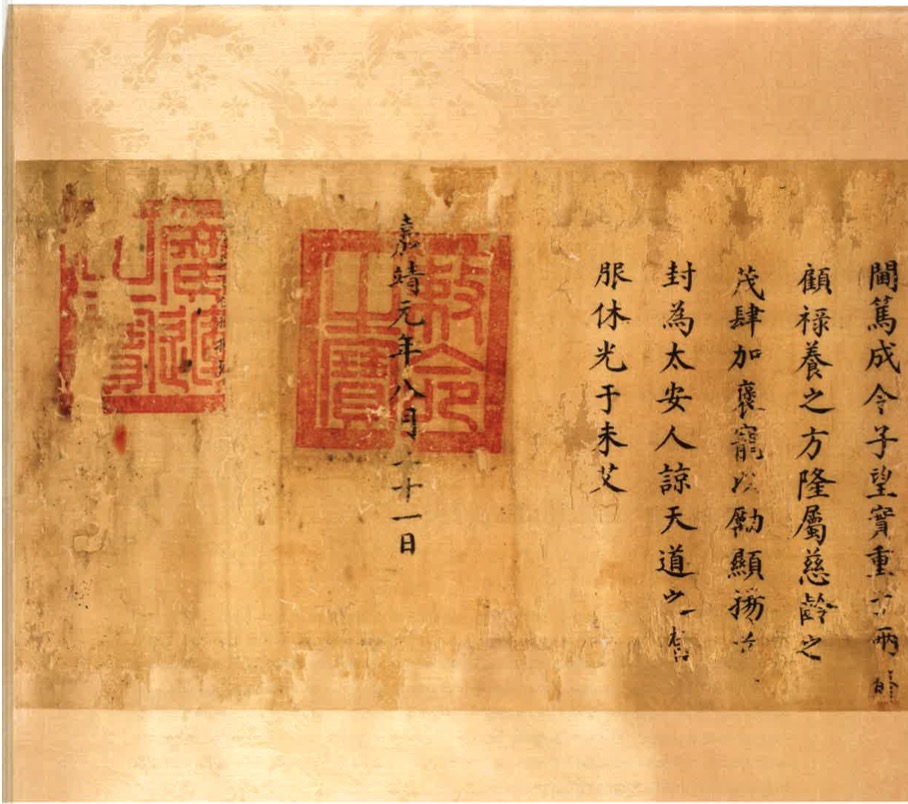
The imperial edict seen here was written in 1522 to honor the parents of official Chen Chen (1477–1546) for raising such an exemplary son. Chen was known throughout his career as an honest, uncorrupted official who contributed much to the good of society. Although the original silk of the scroll is severely damaged, after authentication TBC had the entire scroll restored. Despite the damage, the calligraphy is still perfectly visible except where the silk has frayed away and obscured only a very few characters. The text of the edict reads as follows:
“The Emperor proclaimed that praising the lofty character and abilities of outstanding people is our most important system, and publicizing the virtues of a father and mother are the highest responsibilities of sons and daughters. Moreover, it is natural to bestow favors on ministers for their distinguished service. Chen Ticheng, the father of Chen Chen, the Director of Assessments for the Nanjing Board of Civil Administration, was an honest and unsophisticated man: polite, modest and acquiescent. Tales of his fine conduct in his hometown have circulated, and have brought his family boundless favor. His virtuous and able son’s morality stems directly from his father’s instruction. He has already become an eminent figure, capable of elevating his family’s good name. The effects of his upbringing have already been passed down to the next generation, and the noble departed spirits still demonstrate glorious concern for the son. As such, we commend this man in order to console his son’s longing for his departed father, and we confer upon him the honor of Progenitor of Virtue of the Director of Assessments for the Nanjing Board of Civil Administration. We sincerely hope that the spirits will protect them, and that they may achieve even greater honors.”
The religious devotion and moral character of the mother is manifested in her children’s upbringing. Our country’s system of favoring virtue places the most emphasis on praising and awarding such people. Therefore we want to publicize our debt of gratitude and extend the honor of praise, but only the most virtuous can win this special honor. Miss Wu is Chen Chen’s mother, a woman of innately fine moral quality, born of good ancestry, and adept in rearing virtuous children. Her exemplary behavior has long been talked of, as has her honest feminine virtue. Because we gratefully remember her love and care which grew daily ever stronger, and her kindness which increased with every passing day, we do greatly praise her and encourage others to extol her virtues. We therefore confer upon her the title of ‘wife of a ranking official.’ We strongly believe that the spirits will hear of this honor, giving rise to ceaseless moral excellence and meritorious service. Dated August 21, 1522.”
Chen Chen, also known as Chen Sixian, was born in 1477 to a poor family near Jinjiang city in Fujian province. He began to read at the age of five, and by the age of seven was replying articulately to questions. His father died when he was 18, and so he discontinued his formal studies to support his family, farming during the day and studying on his own at night. In 1498, he took the Fujian provincial examination, but failed the exam because he was unwilling to give bribes. In 1502, his close friend Li Cong introduced him to Cai Qing (1459–1509), an eminent Confucian philosopher of the day. Cai Qing was sufficiently impressed with Chen’s written work to treat him as a friend rather than simply a student, but Chen insisted he become Cai’s student, and studied with him between 1502 and 1506. Between 1506 and 1510 Chen worked as a teacher, even teaching Li’s own two sons. During that time he also completed two books, “An Elementary Introduction to the Four Books” and “An Elementary Introduction to the Book of Changes.” In 1511, he successfully passed the provincial exam, and in 1518 passed the highest imperial examination and received the jinshi degree, the highest degree possible in China at the time.
Chen was first posted to Shanxi province as director of the provincial Board of Punishments. Soon after, he requested a transfer to Nanjing because of his aged mother’s failing health. He then became the director of the Nanjing Board of Revenue, and later became the assessment director for the Nanjing Board of Civil Administration (also known as the Board of Personnel), where he was in charge of assessing officials for promotion and demotion. His uncorrupted office was rarely busy, and students often came to seek out his wisdom and opinions. In 1528 he was recommended for a position at the imperial court, but declined. In 1529, he was recommend for the position of Chief Magistrate of Guizhou, and then for Chief Magistrate of Jiangxi, but he again declined both positions. Despite his success, Chen never had much interest in official life. At some point he built a house on the edge of “Purple Hat Peak” and took the pseudonym “Gentleman of the Purple Peak,” ultimately penning “The Collected Works of the Gentleman of Purple Peak.” Chen died of illness at his home in 1546, and was buried at the foot of Xiulin Mountain in Jinjiang, where his grave can still be viewed today. In 1559, the district magistrate of his hometown had a temple constructed to Chen because of his many contributions to society. This temple was destroyed sometime after the 1950s.