跳到主要内容

The Beijing Center

the beijing center for chinese studies

Sculpture

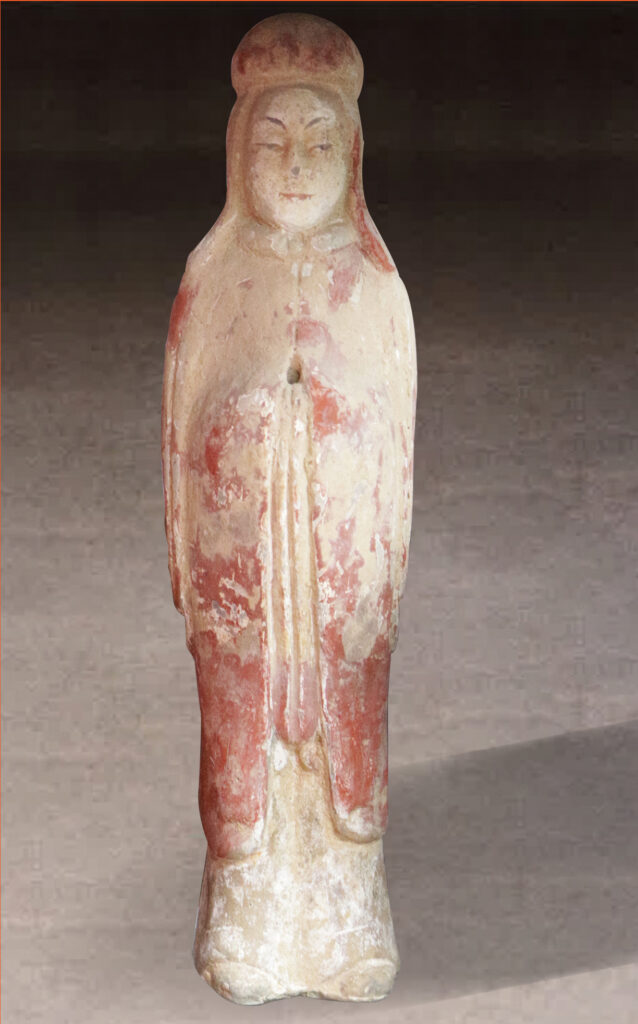
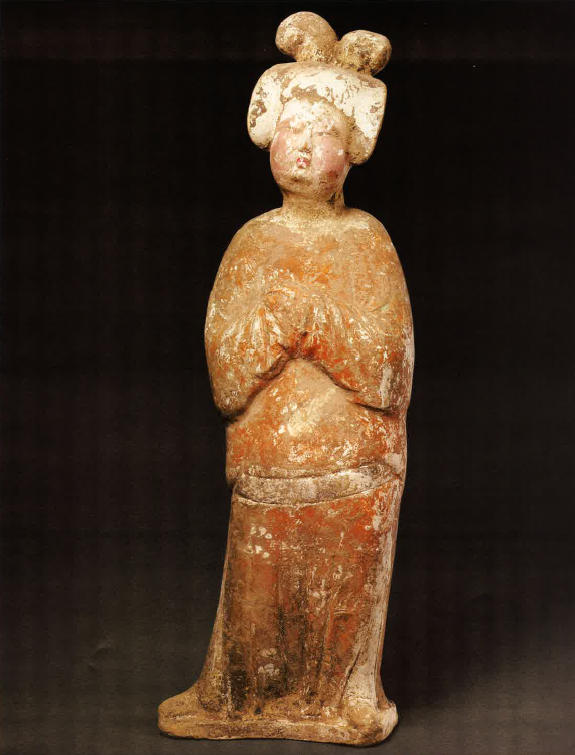
Pottery tomb figure of a “Fat Lady”

information

Tang dynasty (618–907)
Height: 36cm, Width: 11cm, Depth: 10cm
**Oxford Authentication Laboratories thermoluminescence tested, sample no. C105r56

introduction

This figure has very good remains of its original pigments, which allow us to see that she wears a loose, low-waisted, orange-red dress with white flowers which is belted with a black sash at the hips. The long, wide sleeves cover her hands, which she holds folded in to her chest. Her face is delicately painted pink, while her bright red lips indicate the cosmetics which were an integral part of an Tang aristocratic woman’s toilette. Her black hair is elaborately fashioned into a high double-bun at the top of her head, a flamboyant hairstyle favored by the noble and court ladies of the time.

The opulence of the High Tang period (first half of the 8th century) is epitomized by the aesthetic of the statues depicting voluptuous court women, known as “fat ladies.” The Tang emperor Xuanzong (reigned 712-756 CE) is best known for his relationship with his imperial consort, the lushly-proportioned Yang Guifei. This statue’s curvaceous feminine beauty is thought to reflect the style made popular by the concubine, who was notoriously later blamed for distracting the Emperor’s attention from matters of state, eventually leading to the An Lushan rebellion of 755 CE that marked the end of the luxurious High Tang period.
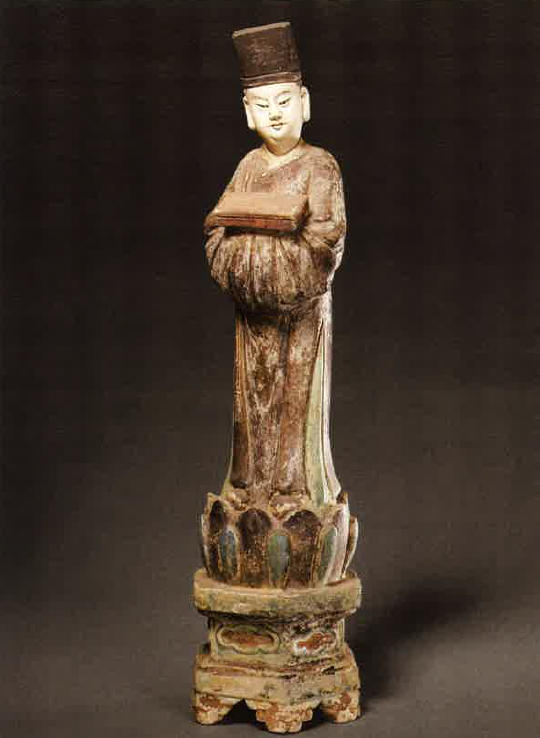
Glazed pottery figure of a scholar

information

Ming dynasty (1368–1644)
Shanxi province
Height: 58cm

introduction

This figure wears a cube-shaped hat painted with black pigment, and a robe glazed in a deep violet-aubergine tone with turquoise accents. The robe is tied at the waist with a tasselled cord that hangs down his right side and a second decorative tassel at the back. He carries a document box painted in red and black, although his hands are hidden inside his sleeves. Ming scholars often wore simple robes in shades of blue and black which wrapped left-over-right, with wide sleeves long enough to cover their hands. These robes were often paired with the cube-shaped casual cap seen here, known as si fang ping ding (“peace in all four directions”).

The figure’s head is removable, and is set at a slight angle to the body. The features of the plump face are deeply and clearly sculpted to emphasize the eyes, nose, mouth and double-chin. The pupils, eyebrows and hair at the temples are delineated with black pigment, while the sculpted ears have unusually long earlobes. The delicate molding of the face gives this otherwise-stiff figure a more sympathetic feel, his benign expression made more interesting by the care with which the features and expressions were sculpted. The figure stands on a lotus base atop a hexagonal decorative base, glazed in the same aubergine-brown and turquoise as the figure’s robes. This particular base is an unusual choice for such a figure, both because of its ornateness and the lotus flower’s connection with Buddhism. This figure probably would have originally been part of a larger set, which would most likely have been placed on similar bases.

Pottery tomb figure of military drummer

information

Six Dynasties period, Northern Wei dynasty (386–534)
Hebei or Henan province
Height: 23cm

introduction

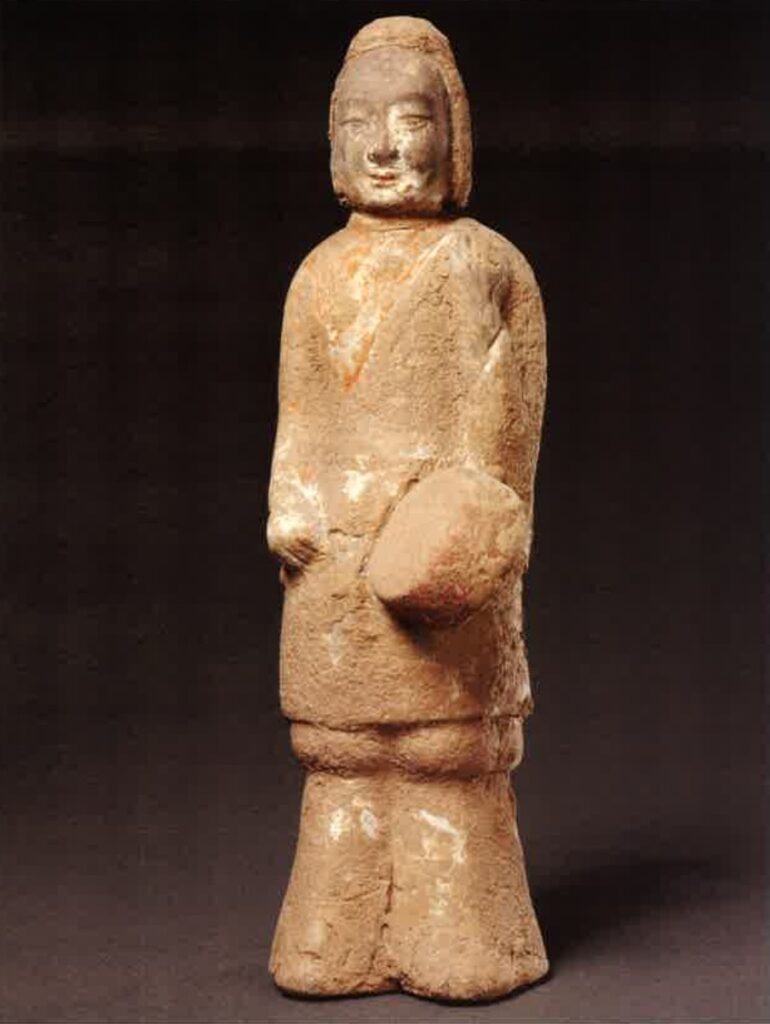
Although lead glazes such as those used on the Han dynasty jars were also used on contemporary tomb figures, those figures created during the following Six Dynasties period (220–589) were usually painted rather than glazed. The war and chaos of the period, which saw thirty different dynasties contending for power over a period of more than 350 years, is reflected in a rise of processions of military figures buried in the tombs of the ruling classes. This figure of a military drummer is carefully molded with such detail that even the folds of his sleeves are still visible through the earth encrustations. The round, smooth face, with its gentle, subtle expression, is characteristic of the influence of Buddhism on Northern Wei tomb figures. The figure is dressed as a warrior in a Chinese-style loose-sleeved robe which opens to the right, and trousers tied at the knees for mobility. Traces of the original red pigmentation and white slip can still be seen.

Painted pottery prancing horse

information

Tang dynasty (618–907), second half of 7th century
Fongxian area near Xi’an, Shaanxi province
Height: 30cm Length: 29cm Width: 12cm

**Oxford Authentication Laboratories thermoluminescence tested, sample no. C106b97

introduction

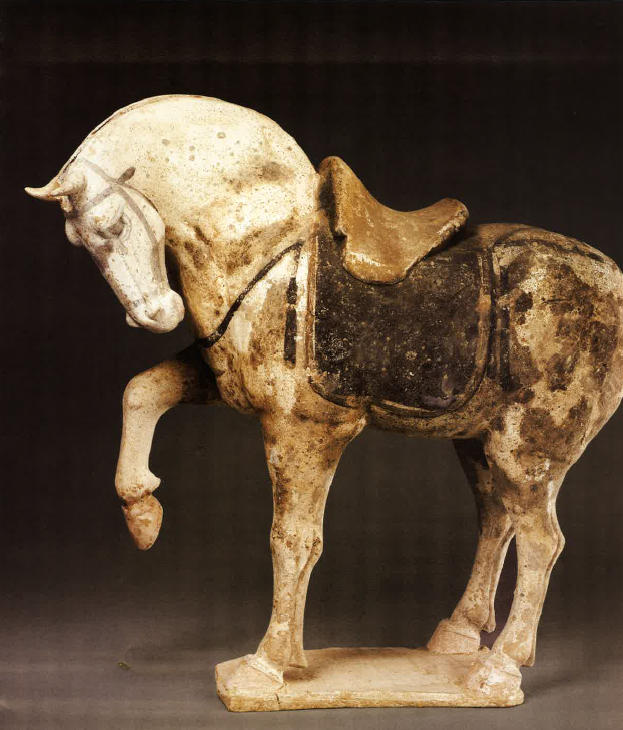
Painted overall with white slip, this horse has a molded red saddle and black saddle blanket, while the bridle and other trappings are painted with black pigment. This piece is elegantly proportioned with a muscular neck to balance the powerful hindquarters, while the strong curve of the neck and head emphasize the bend of the right leg raised in a prancing pose. The artist’s decision to tilt the horse’s head slightly to the left lends naturalism to what otherwise would have been a very stiff posture. This horse would have originally had a mane and tail of real horsehair, fitted into the trough on the neck and the hole between the hindquarters. With the exception of the ear tips, the piece is unbroken – a rare find, as early Tang pieces such as this often require repairs.

Horses are one of the most popular subjects for art created during the Tang dynasty, which reflects the importance the Tang aristocracy placed on horses and equestrian activities. It was common for Tang nobility to raise horses for leisure activities such as hunting and polo as well as for military purposes. Tang pottery horses can be as large as a meter in height, making for massive pieces which show off the animals’ strength and power, qualities clearly prized during the period. Although this piece is much smaller, its superb modeling, careful attention to detail and excellent condition make it a fine example of early-Tang painted pottery horses.
Tomb pottery figure of foreign groom

information

Tang dynasty (618–907), early 7th century
Xi’an area, Shaanxi province
Height: 32cm

**Oxford Authentication Laboratories thermoluminescence tested, sample no. C105g17

introduction

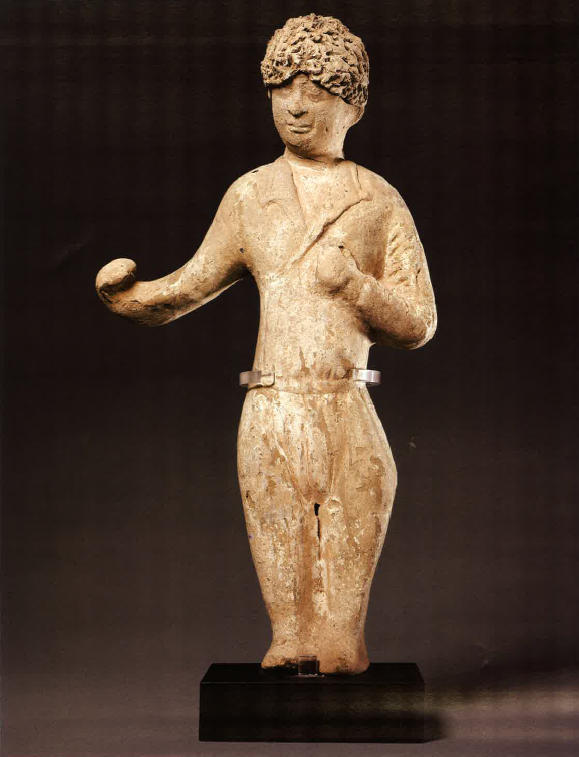
The cosmopolitan Tang taste for exotica and equestrian activities was combined in the contemporary fascination with the foreign grooms who were skilled in caring for the magnificent imported horses prized by the Tang aristocracy. This groom is standing as if holding a horse’s reins in his hands. He wears a wide-lapelled coat tucked into loose, blousy trousers. His curly hair, large nose and round eyes mark him as a foreigner. Figures of foreigners with curly hair, such as this one, are believed to represent the people who came from the southern Middle East and North Africa. Foreigners of all kinds were a common sight during the Tang dynasty, especially in the capital city of Chang’an (present-day Xi’an).

Sancai-glazed court lady

information

Tang dynasty (618–907)
Luoyang area, Henan province
Height: 26cm Width: 9cm Depth: 7cm

**Oxford Authentication Laboratories thermoluminescence tested, sample no. C205c68

introduction

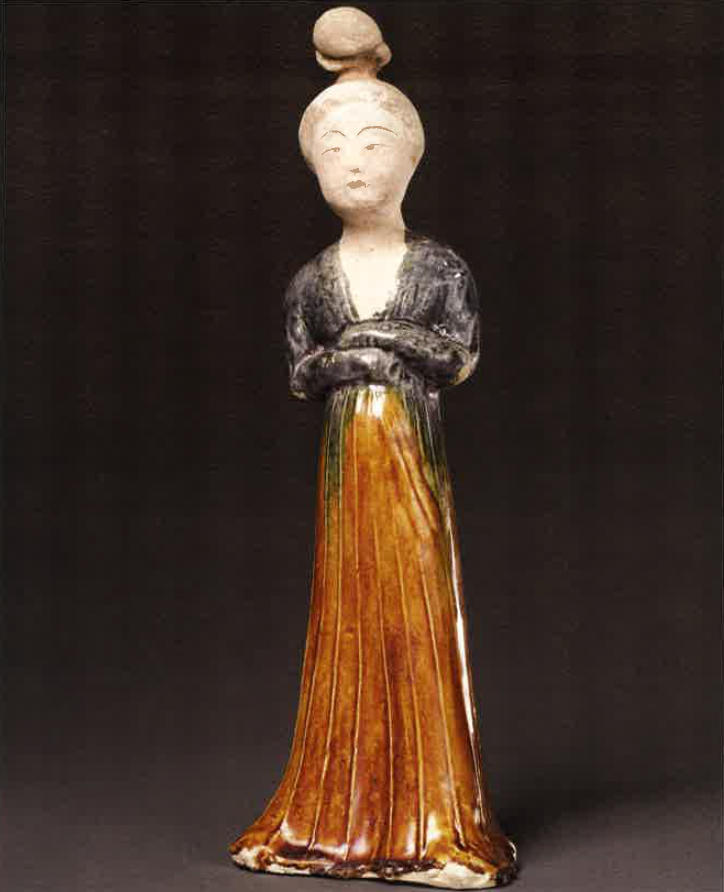
This graceful sancai-glazed figure wears a blue and brown gown belted high on the waist and cut low to reveal deep, molded decollété. Her black hair is gathered into a high, loose bun above delicately-painted eyes and eyebrows, and subtly-tinted pink cheeks and red lips. Her hands are hidden inside long, closely-fitted sleeves which fit her folded arms tightly.

The term sancai or “three-color glaze” typically refers to a lead glaze which fires into a combination of white, green and orange-brown, but also includes purple and blue, such as on this figure. The use of the blue glaze is rare, because it was reserved for the court and nobility. Firing was completed in two stages, with a layer of white slip applied to the piece before glazing to lend the finished glaze a clearer, brighter color than if applied to an unprepared body because the iron content in the clay would have discolored the glaze. Sancai-glazed wares were often used for mortuary objects, including vessels and figures such as this one.

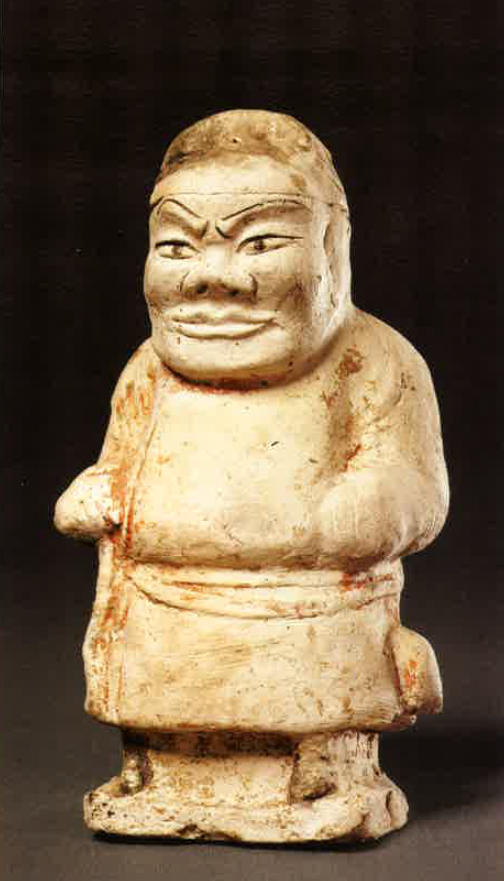
Painted pottery dwarf

information

Tang dynasty (618–907), 7th-8th century
Shaanxi province
Height: 19cm Width: 8cm Depth: 4.5 cm

introduction

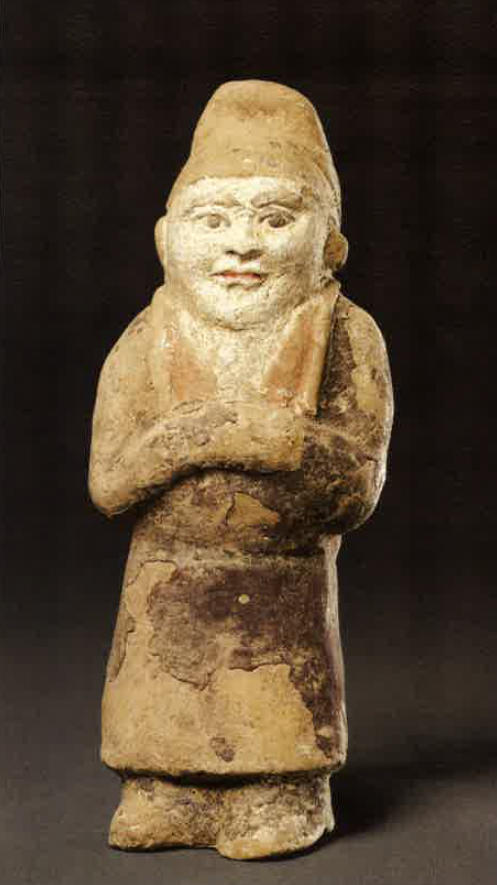
These two painted pottery dwarves are similarly dressed with a black futou (turbaned) coiffure and a tight-sleeved robe belted at the waist. Typically, dwarf figures were painted rather than glazed. Traces of pigment remain on both, particularly on the taller figure. Both have finely-modeled expressive faces: the shorter dwarf with a wide, almost porcine nose, furrowed brow and large mouth; the larger dwarf with a calmer expression, black-tinted irises and red-painted lips. The smaller dwarf holds a snake in his right hand, a comic detail which takes on a menacing aspect given his intense expression. Ceramic dwarf figures were essentially standardized during the Tang period, although ceramic dwarves are found as early as the Han period.
During the Tang period, dwarves were considered incapable of rigorous physical labor, and turned instead to entertainment as the means to make their living. Some worked as street performers, others exchanged their entertainment services for a living in a wealthy household. But they were still considered to be slaves, and could even be sent as tribute from neighboring kingdoms to the Tang court.

Painted pottery dwarf with snake

information

Tang dynasty (618–907)
Luoyang area, Henan province
Height: 16cm Width: 9cm Depth: 6cm

introduction

These two painted pottery dwarves are similarly dressed with a black futou (turbaned) coiffure and a tight-sleeved robe belted at the waist. Typically, dwarf figures were painted rather than glazed. Traces of pigment remain on both, particularly on the taller figure. Both have finely-modeled expressive faces: the shorter dwarf with a wide, almost porcine nose, furrowed brow and large mouth; the larger dwarf with a calmer expression, black-tinted irises and red-painted lips. The smaller dwarf holds a snake in his right hand, a comic detail which takes on a menacing aspect given his intense expression. Ceramic dwarf figures were essentially standardized during the Tang period, although ceramic dwarves are found as early as the Han period.
During the Tang period, dwarves were considered incapable of rigorous physical labor, and turned instead to entertainment as the means to make their living. Some worked as street performers, others exchanged their entertainment services for a living in a wealthy household. But they were still considered to be slaves, and could even be sent as tribute from neighboring kingdoms to the Tang court.

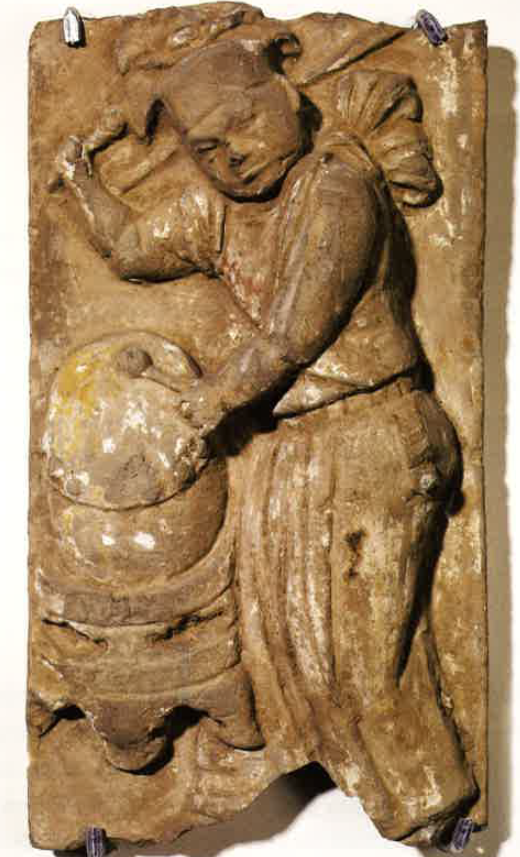
Drummer Panel

information

Possibly Tang dynasty (618–907)
Height: 32cm Width: 18cm

introduction

Sculpted in high relief, this panel bears traces of pigment which indicate it was originally painted. It depicts a figure wearing a cap and a long-sleeved shirt tucked into flowing pants. His sleeves are tied behind his back out of his way to facilitate the freedom of arm movement required to beat his drum. He holds a mallet in each hand, with one mallet just falling on the drumhead and the other raised high, giving the figure a clear sense of movement through this single dynamic gesture. His drum is placed on a carved stand, and we can see how the animal skin is stretched over the top of the drum from the way it is angled toward the viewer. Drum music was very popular during the Tang period, especially that from the Kucha area along the Silk Road.

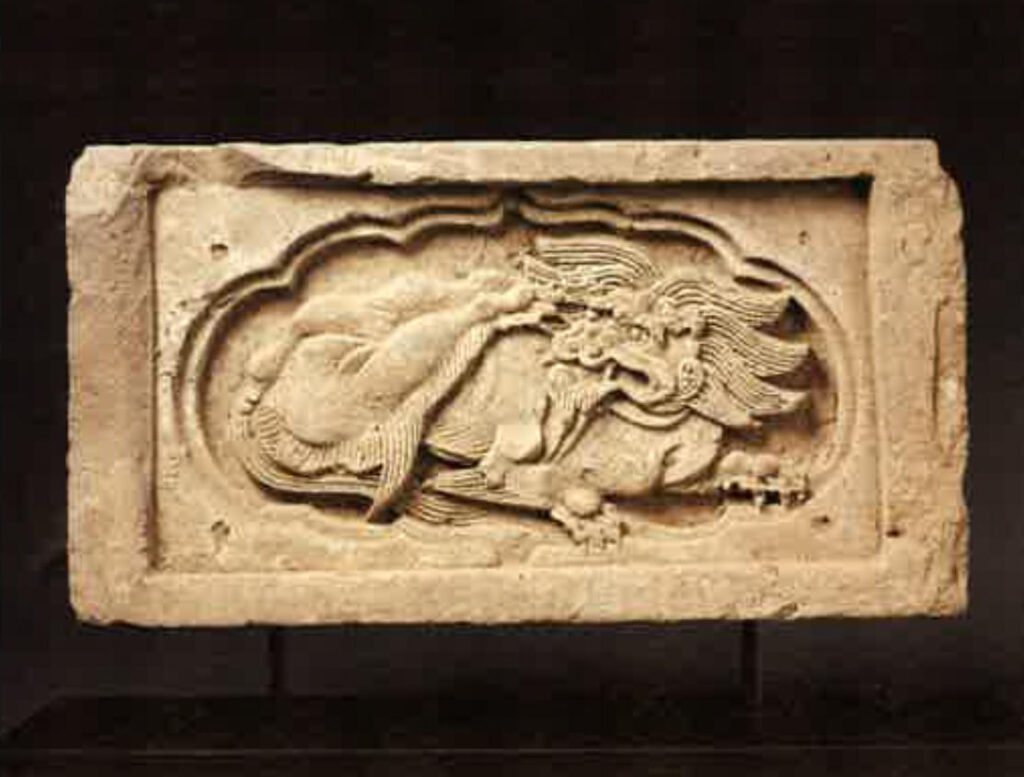
Ceramic tomb tile of a mythical beast

information

Song dynasty (960–1279)
Height: 16cm Length: 30cm Width: 5cm

introduction

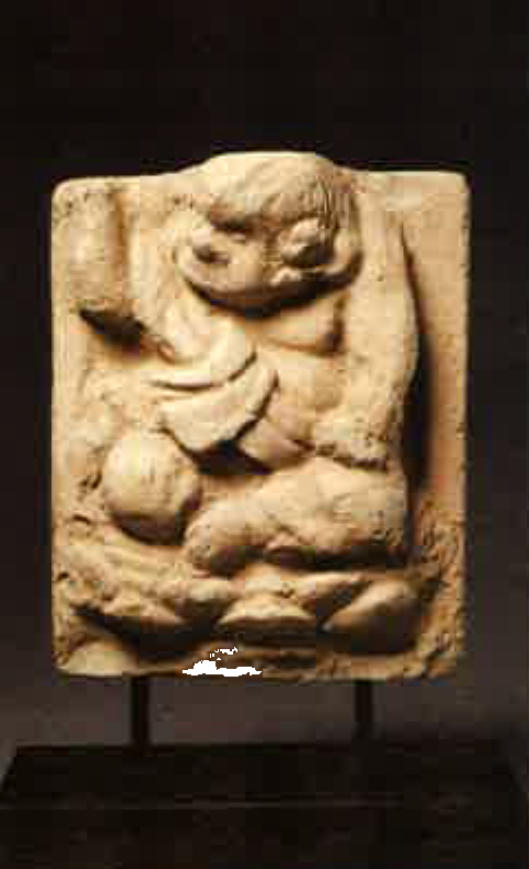
Requires further research / Needs further investigation

information

Yuan dynasty (1271–1368)
Height: 17cm Width: 13.5 cm Depth: 7 cm

introduction

The earlier tomb tile is deeply and crisply impressed with the image of a mythical beast which would likely have had a protective symbolic value for the deceased. The later tile is molded in high relief with a dwarf storyteller, known as a payu. In Chinese culture, tomb decoration was extremely important: it was common for the wealthy and nobility to line their tombs with tiles or bricks decorated with all manner of images and symbols. The objects and representations found in tombs are often considered to reflect elements of contemporary life as well as to indicate what the living believed the dead would need in the afterlife – including, as with these tiles, both spiritual and/or physical protection as well as entertainment.

Pottery tomb figures of male and female attendants

information

Ming dynasty (1368–1644)
Female Height: 31cm
Male Height: 37cm

introduction

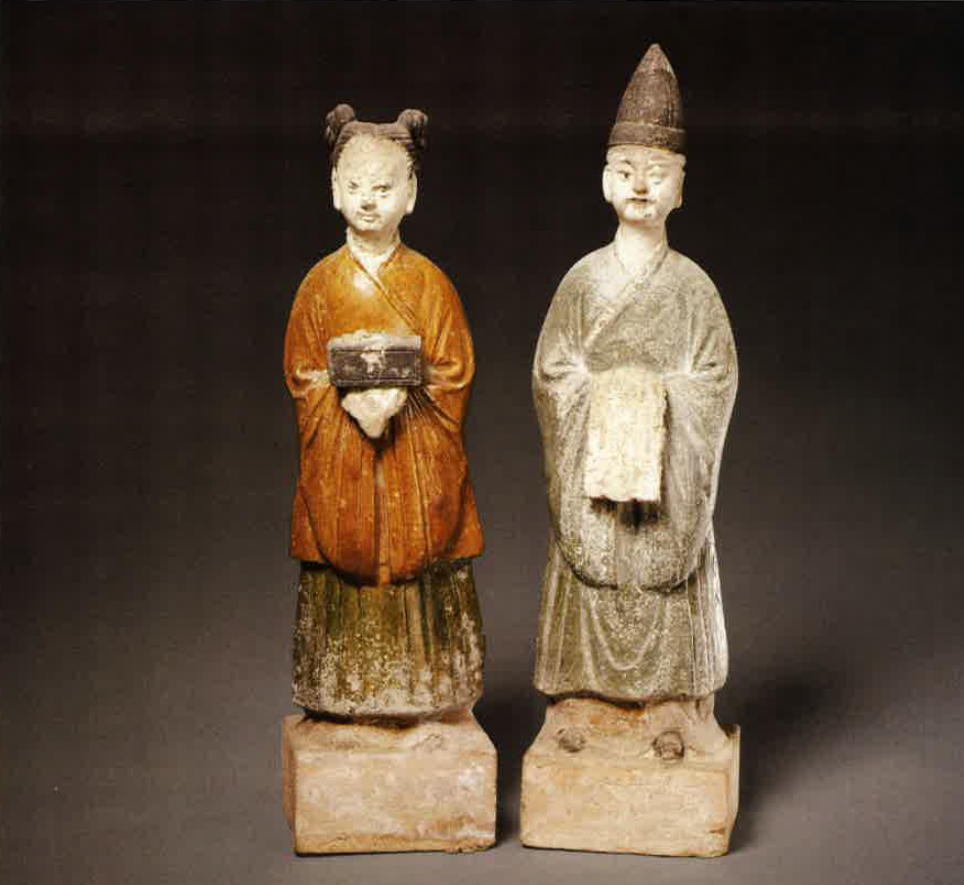
Both of these ceramic tomb figures are glazed in sancai three-color glaze. The female attendant wears a knee-length wrapped robe in amber-brown and an olive-green full skirt. Her molded hair is parted in the center and combed into two elaborate coils at either side of her head. In her hands she carries a rectangular box. Both her hair and the box are cold-painted with black pigment rather than glazed. The male figure wears a long green wrapped robe with full sleeves, below which we can just see the amber-brown skirt of an under-robe. His hair is gathered up tightly inside a tall, pointed cap. He carries a piece of textile in his hands which drapes towards the floor, its folds mimicking the folds in his robe. The faces of both figures are gently molded and then accentuated with black pigment. Although the widespread practice of including ceramic figures in the tomb was waning during the Ming dynasty, they could still be employed as status symbols by royalty, nobility, and officials.

Painted pottery figures of twelve ministers holding the calendrical animals

information

Ming dynasty (1368–1644)
Shanxi province
Height: 17cm

introduction

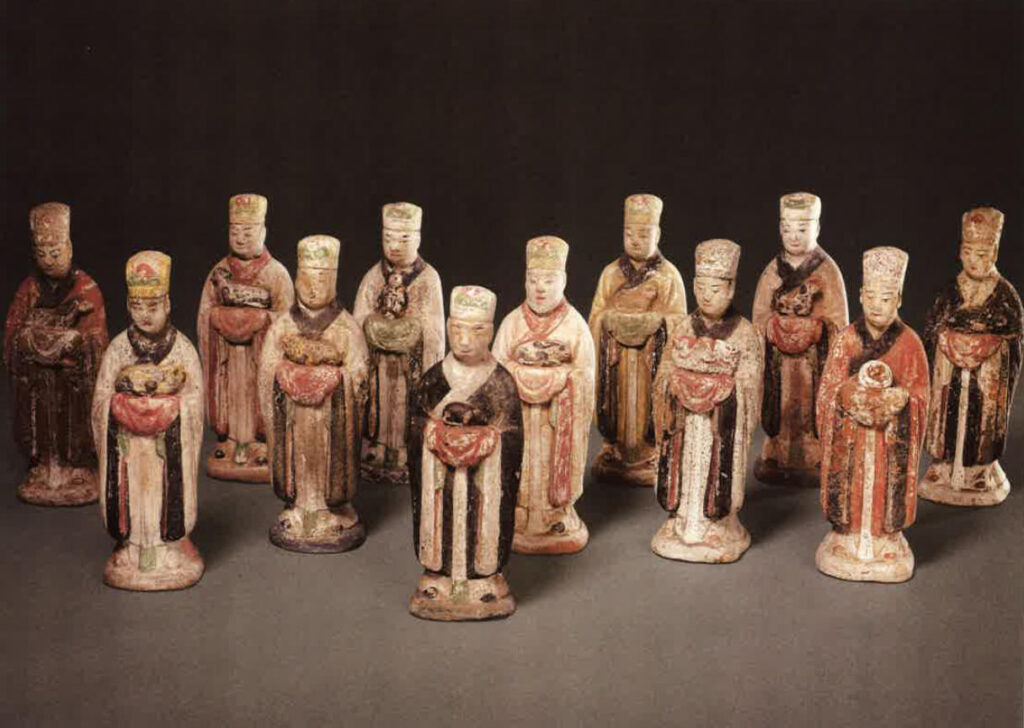
These twelve figures are all dressed as Ming officials in tall hats and long robes bordered with a contrasting color, while their hands are hidden under wide, flowing sleeves. They each carry a different calendrical animal atop a colored drape. The figures were cold-painted in bright pigments, with excellent remains of the original colors. Their features are also picked out in color, enlivening their otherwise-identical faces and figures.

The twelve calendrical animals (sometimes called the animals of the Chinese zodiac) represent a twelve-year cycle in which each year is associated with a particular animal. The twelve animals combine with the “ten heavenly stems” to form the full Chinese calendrical cycle of sixty years. In order, these animals are: rat, ox, tiger, rabbit, dragon, snake, horse, goat, monkey, chicken, dog and pig. These twelve animals and their sequence were fixed by the Han dynasty, although this calendrical concept appeared even earlier. In modern China, the practice of identifying age with the animal of one’s birth year is still popular, and certain years are considered more auspicious for certain events than other years. Figures depicting these animals, either the animals themselves (often dressed in human robes) or human figures carrying the animals (such as the ones seen here) can be found throughout Chinese history. Possibly the most famous examples were the twelve bronze fountainheads depicting the calendrical animals which were loosed from the Yuanming Yuan by the French and British troops in 1860. Four of the heads have since been recovered, and are now on display in Beijing’s Poly Museum.

Tomb Furniture

information

Ming dynasty (1368–1644)
Shanxi province
Chest: Height: 8.5 cm Length: 13cm Width: 8cm
Table: Height: 11cm Length: 16cm Width: 11cm
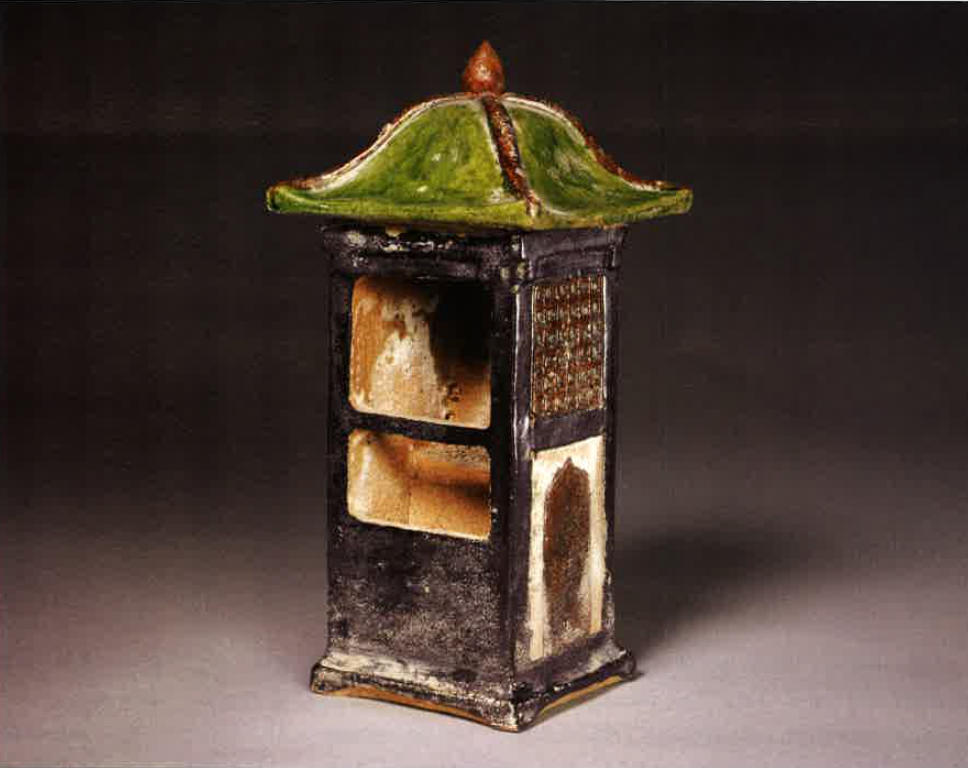
Sedan Chair: Height: 26cm Width: 13cm Depth: 11.5cm

introduction

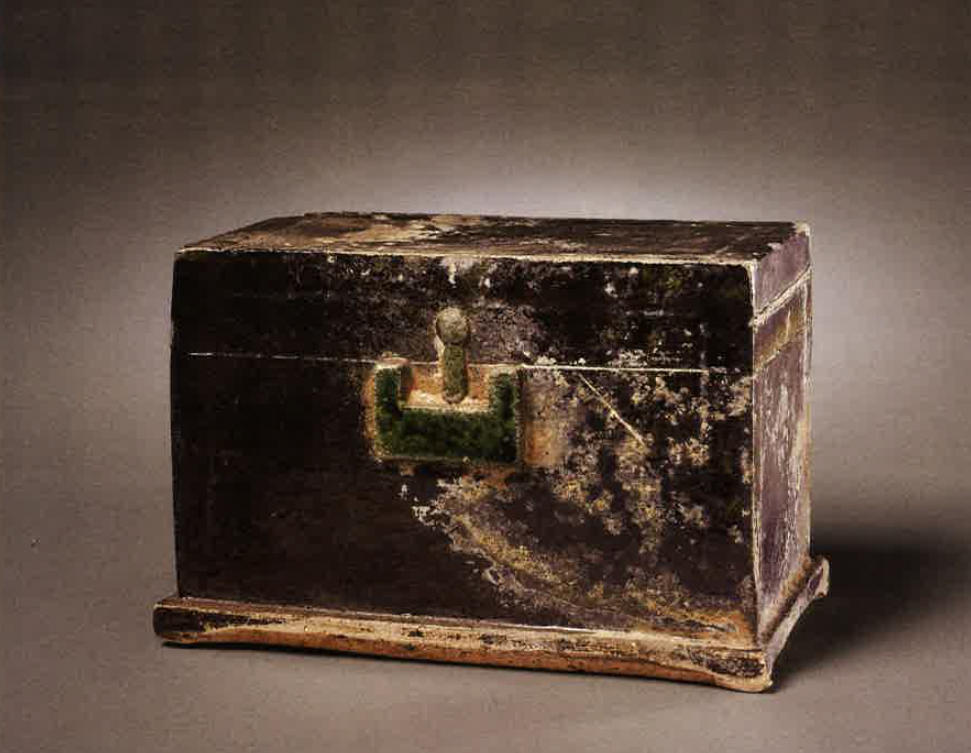
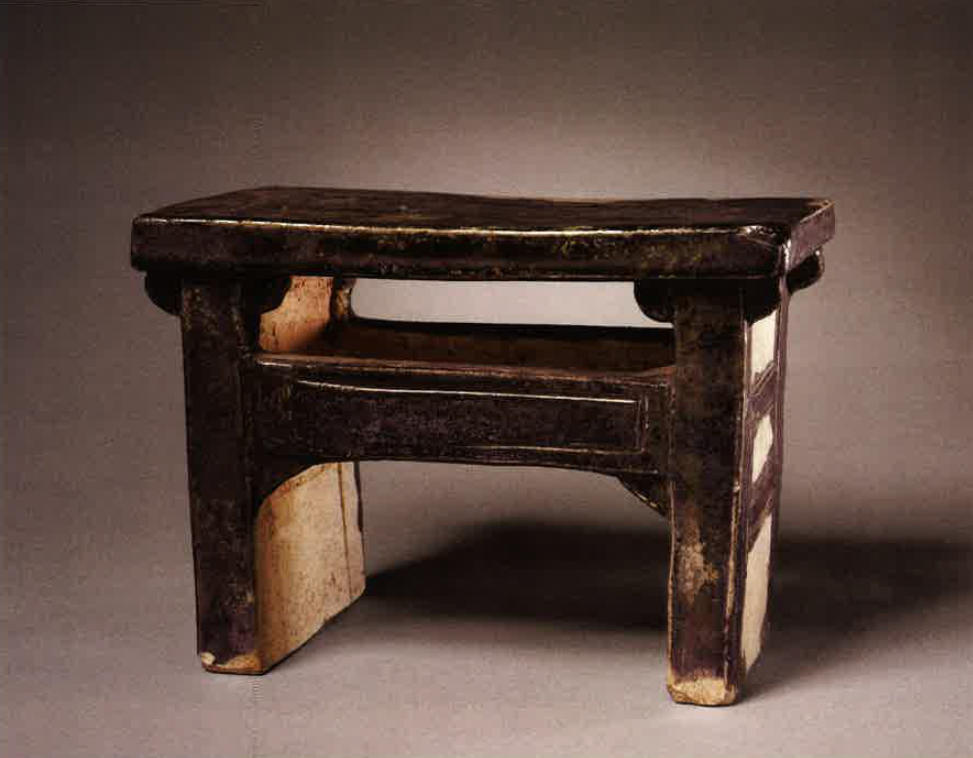
These three small furniture facsimiles are representative of the types of Ming ceramic tomb furniture, and likely imitate real furniture from the period. The chest is glazed in black with a green-glazed lock and hinges. The lid was outlined by scoring the clay while it was still soft. The table is also glazed in black, with its details also scored into the clay. On this piece the buff-colored biscuit is still visible on the shorter sides of the table in an attempt by the artist to give the impression of braces between the legs without sacrificing the ease and stability of a slab construction.
The sedan chair is the most complex of all three pieces. It has a green-glazed pagoda roof with deep amber-brown accents and pointed finial. The lattice is finely molded and carefully glazed to imitate a real sedan chair’s lattice. The body of the chair is molded of buff pottery glazed black, with decorative lower panels left partially unglazed to contrast with a patch of wall that is glazed amber-brown. Four small holes carefully aligned below the lattice on each of the right and left sides indicate that thin sticks originally passed through, mimicking the bearer-poles on a real, full-sized sedan chair.

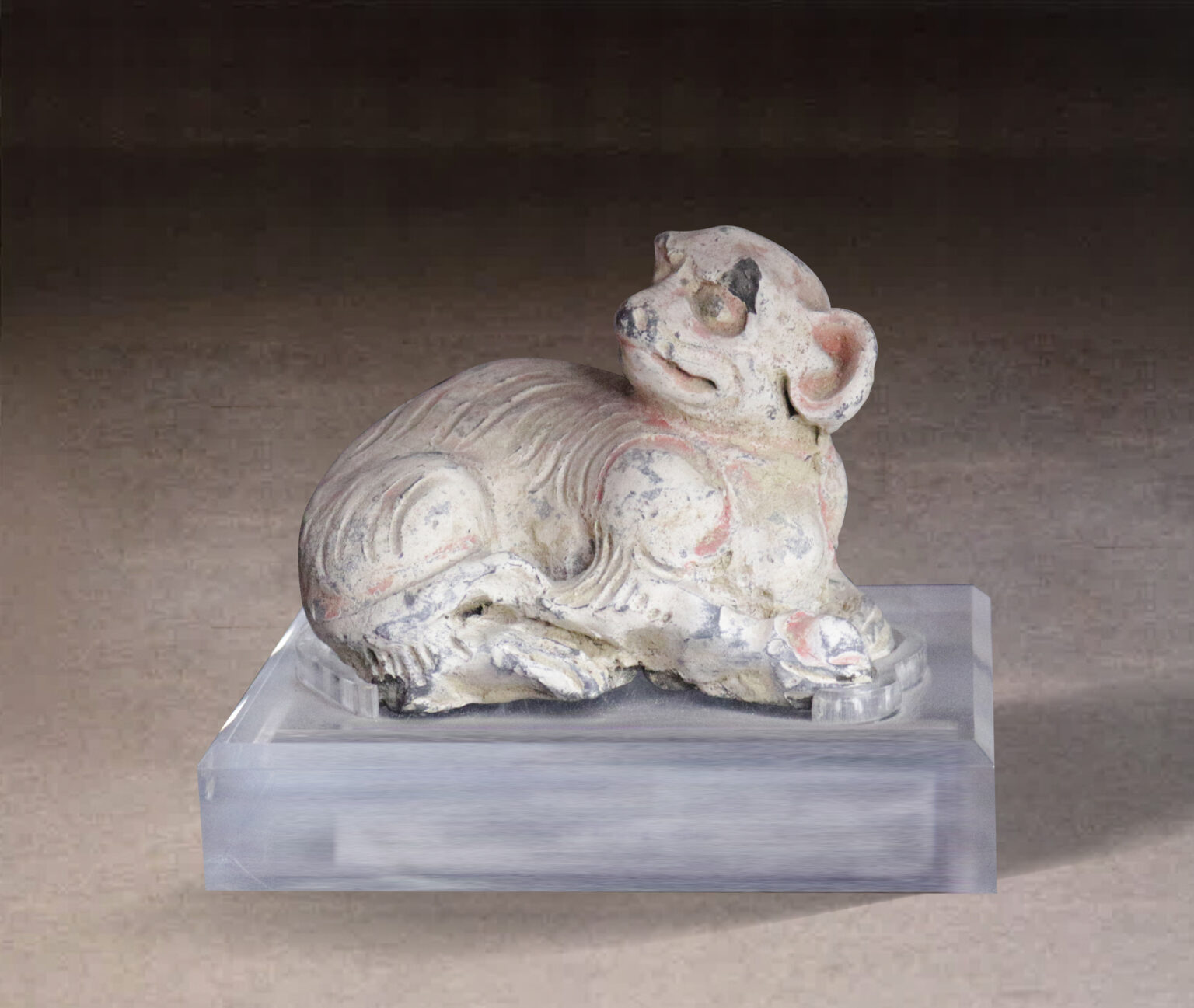
Pottery Figure of a Monkey

information

Yuan dynasty (1271–1368)
Northern China

introduction

Information pending… 

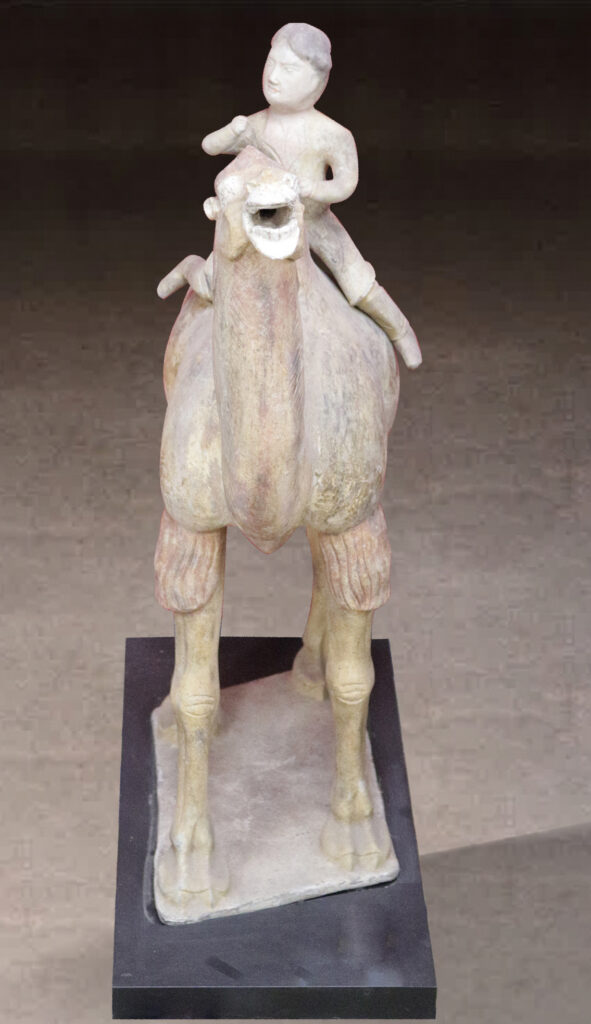
Painted PotteryFigure of a Camel with Rider

information

Early 7th Century
Tang dynasty (618–907)
Gansu Province

introduction

Information pending… 

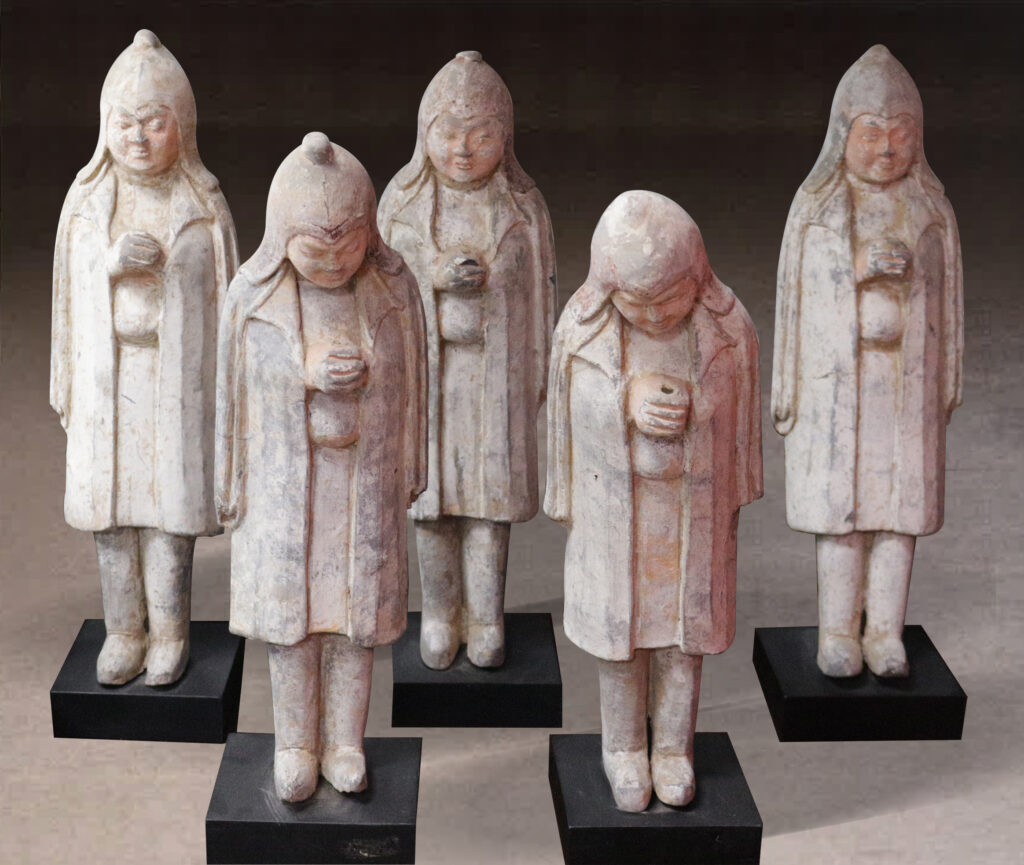
Five Rare Pottery Figures of Officials

information

Six Dynasties,
Northern Zhou dynasty (557–581)
Shaanxi Province

introduction

Information pending… 

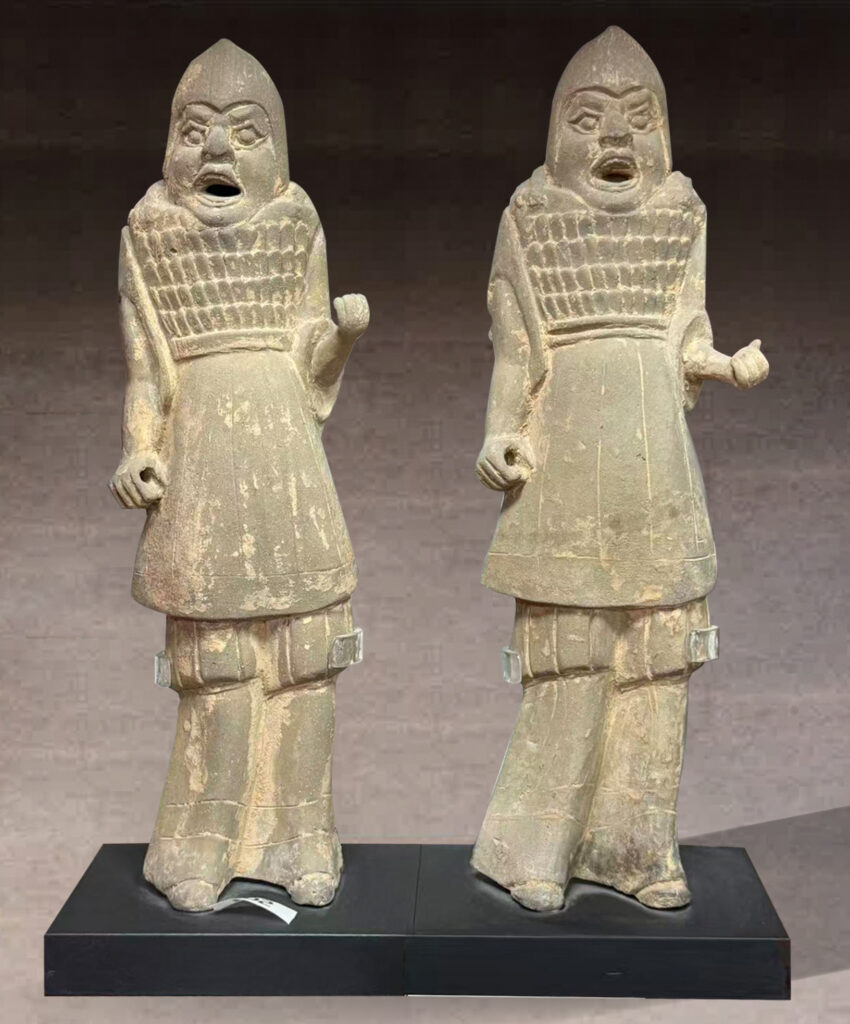
Pair of Pottery Figure of Guardians

information

Six Dynasties
Early Northern Wei (386–534)
Hebeior Henan Province

introduction

Information pending… 

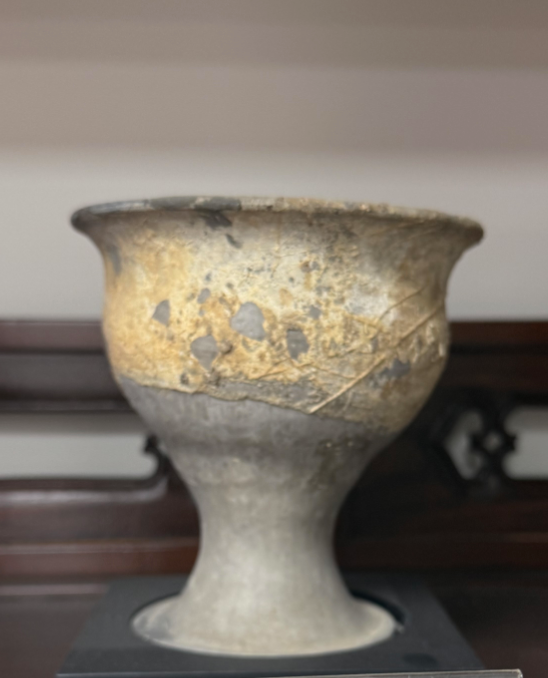
Painted Gray Pottery Stem Cup

information

Han dynasty (206 BCE–220 CE)
Shaanxi Province

introduction

Information pending… 

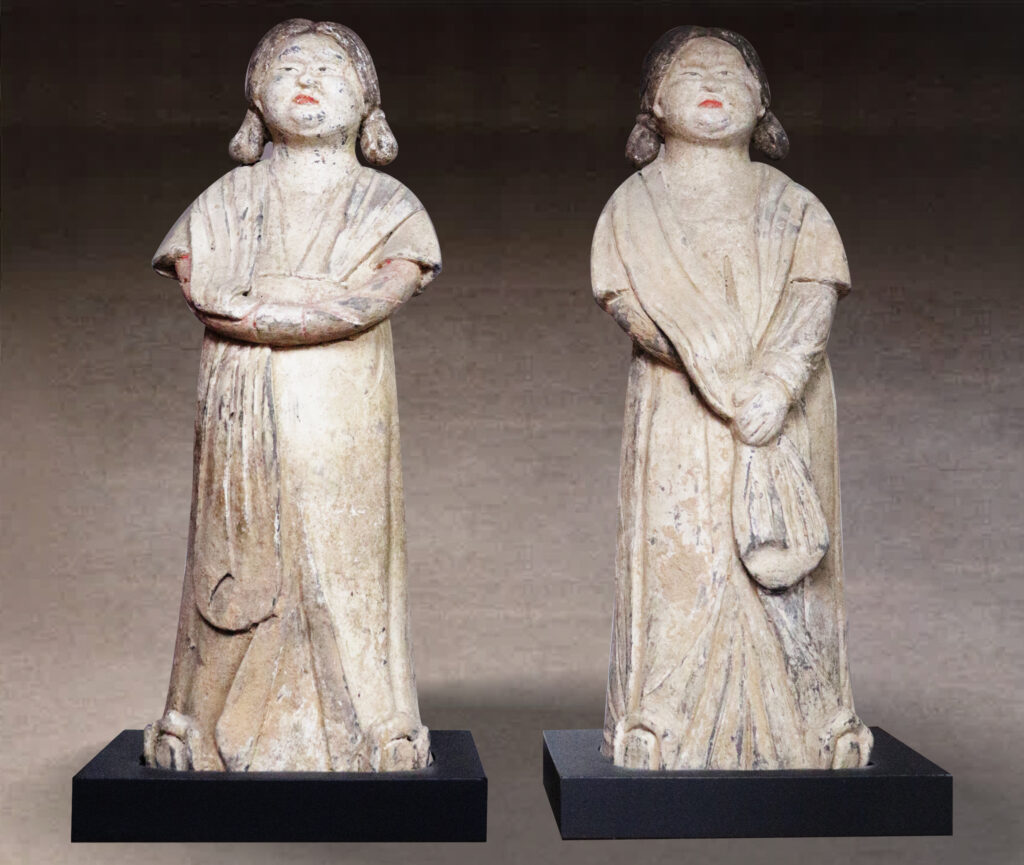
Pair of Painted Pottery Fat Ladies

information

Early 7th Century
Tang dynasty (618–907)
Xian area, Shaanxi Province

introduction

Information pending… 

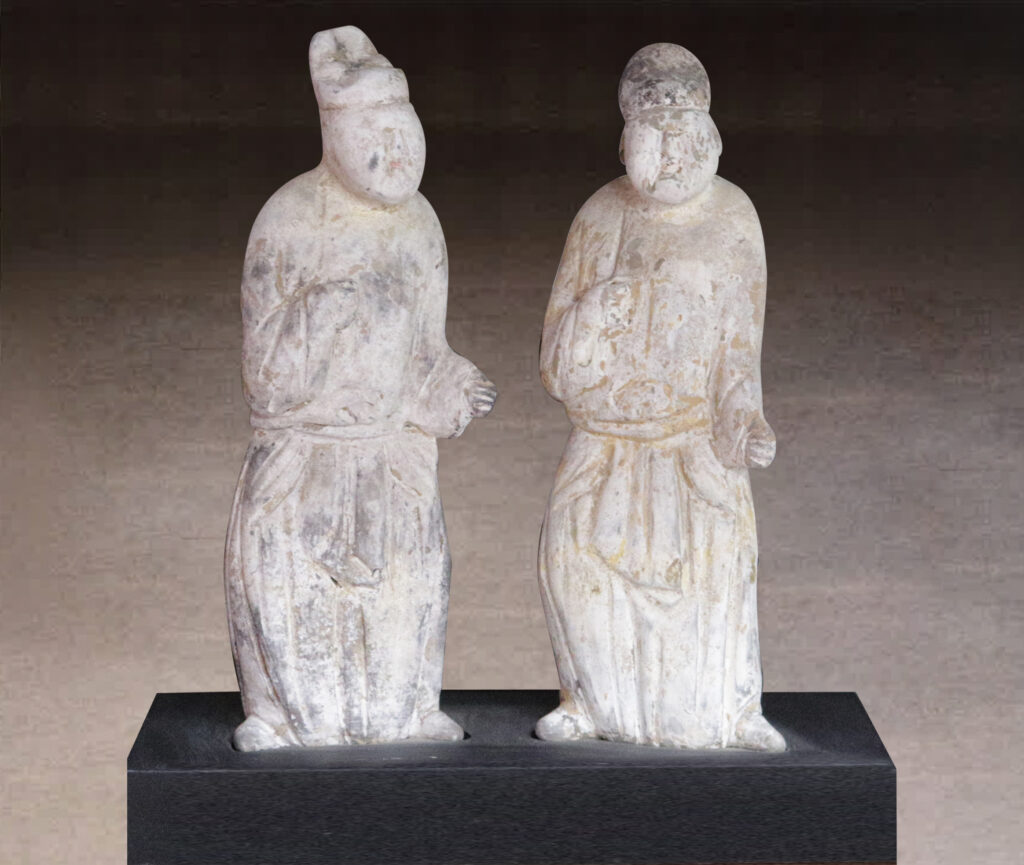
Pair of Painted Pottery Dignitaries

information

Early 7th Century
Tang dynasty (618–907)
Shaanxi Province

introduction

Information pending… 

Painted Pottery Figure of a Dignitary

information

Six Dynasties period
Northern Qi dynasty (550–577)
Shaanxi Province

introduction

Information pending… 

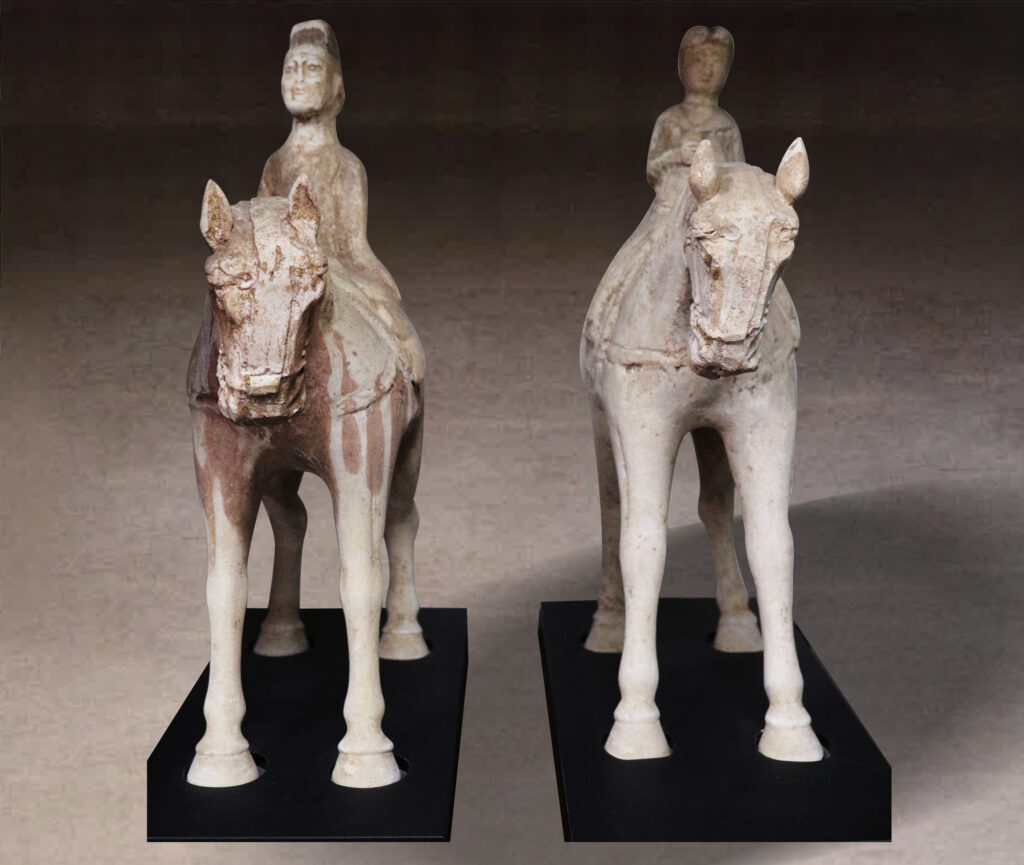
Painted Pottery Figures of a Male and Female Equestrians

information

Sui Dvnasty (589–618)
Luoyang area, Henan Province

introduction

Information pending… 

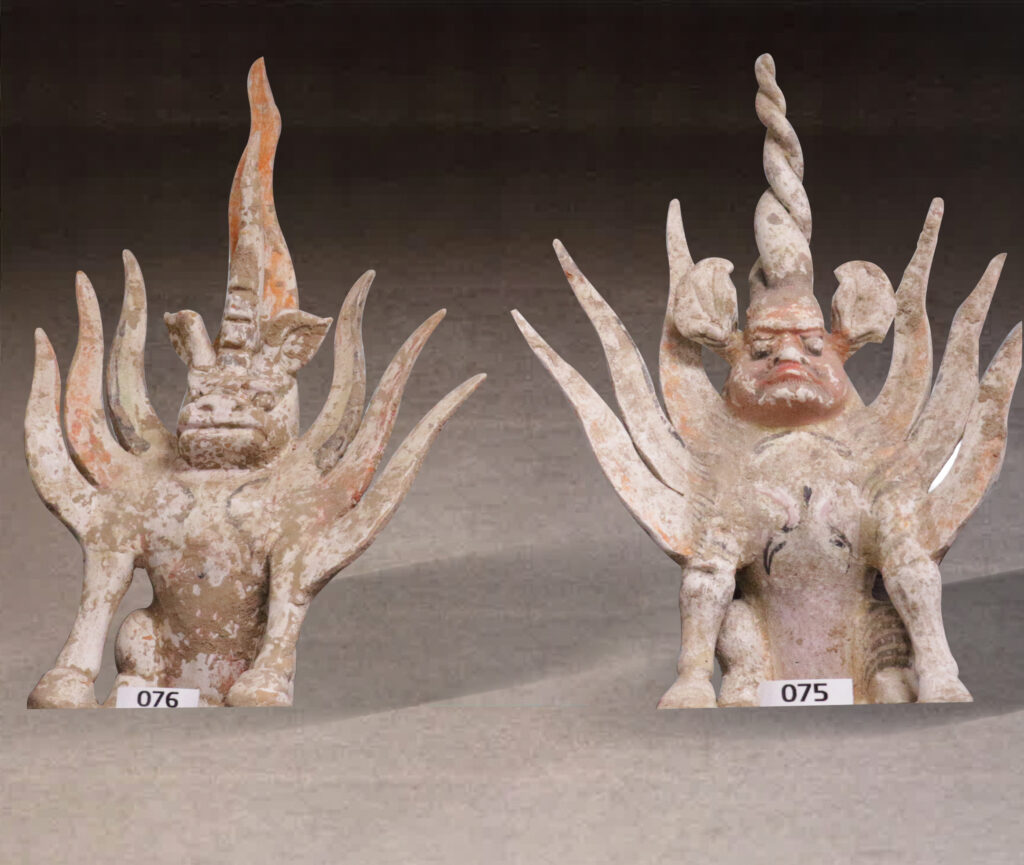
Pair of Painted PotteryEarth Spirits

information

Tang dynasty (618–907)
Fongxian area near Xian, Shaanxi

introduction

Information pending… 

Ceramic Tomb Tile of a Dwarf Storyteller

information

Yuan dynasty (1271–1368)

introduction

Information pending… 

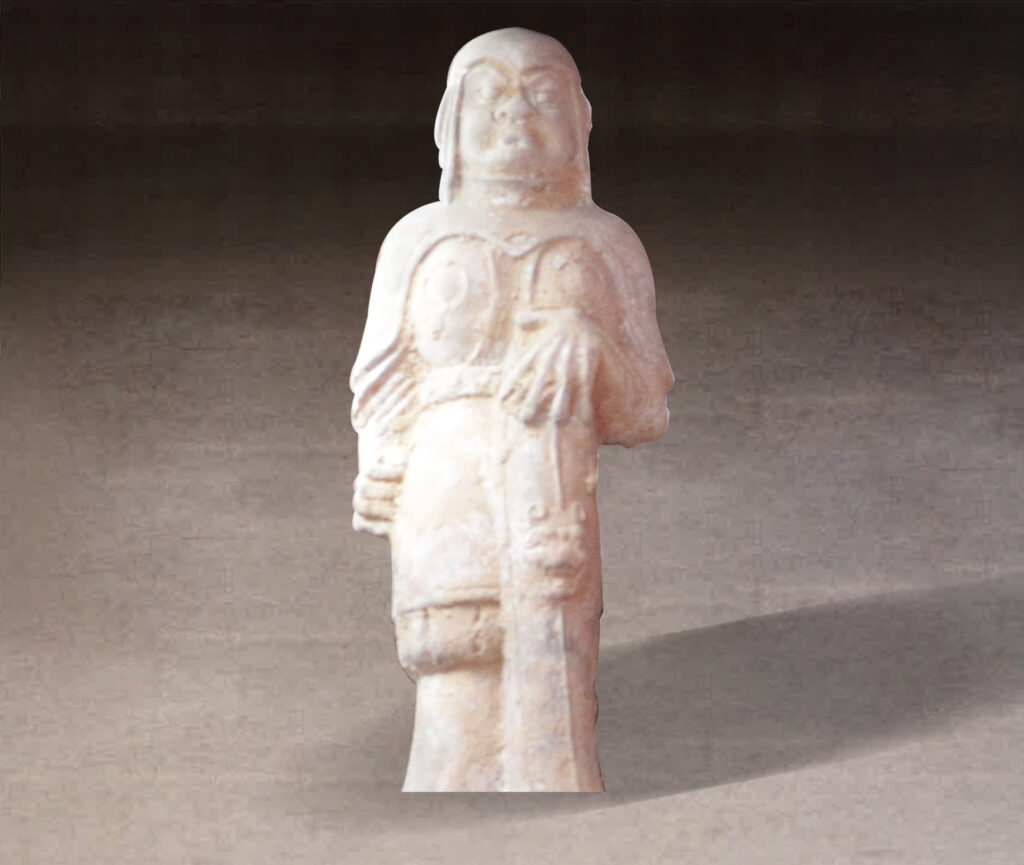
Painted Warrior Figurine with Shield

information

Northern Qi dynasty (550–577)
Anyang, Henan

introduction

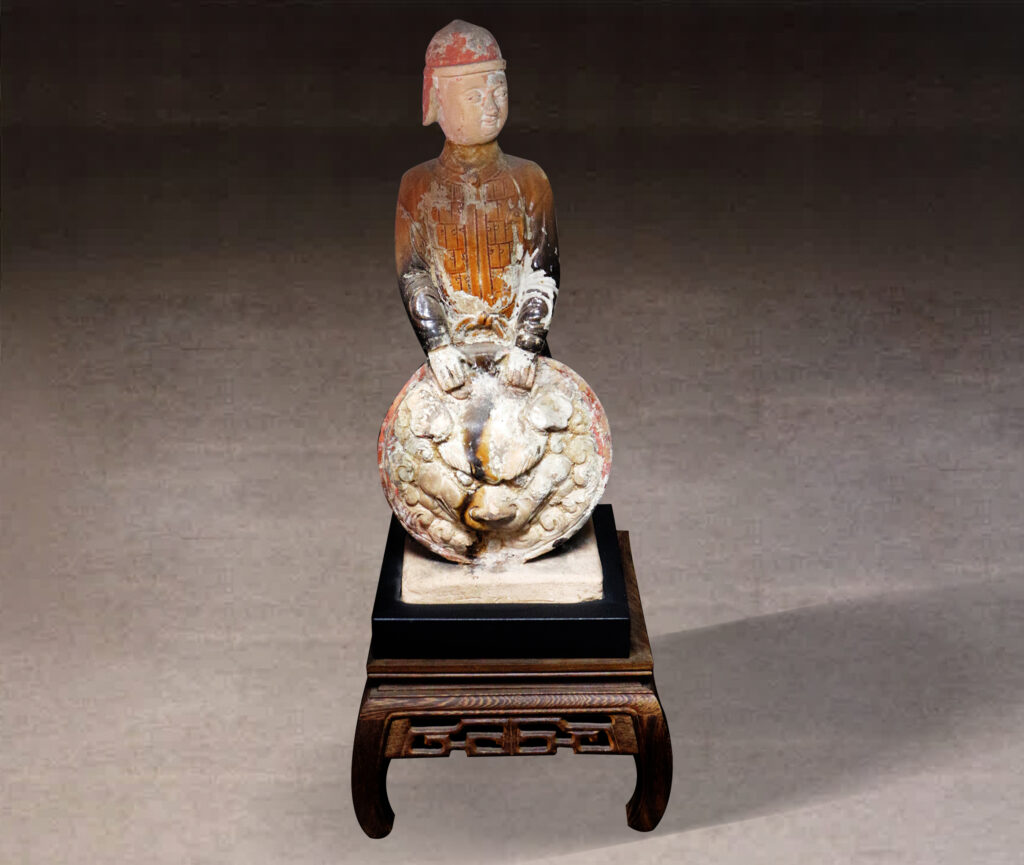
This painted warrior figurine with a shield is a relic from the Northern Qi dynasty, dating to the 6th year of the Wuping reign (575 AD; the Northern Qi dynasty lasted from 550 to 577 AD). It was excavated in Anyang City, Henan Province in 1971.

The warrior wears a helmet and bright-light armour fitted with two large round breast plates. His left hand rests on a long shield adorned with a tiger-head beast mask pattern, while the weapon originally held in his right hand has decayed. As a typical tomb guardian figurine of the Northern Dynasties, it was placed in the tomb to protect the tomb occupant and ward off evil. The tomb owner, Fan Cui, once served as General of Agile Cavalry and Governor of Liang Prefecture. This clearly dated artifact is a landmark representative of Northern Qi pottery figurines.

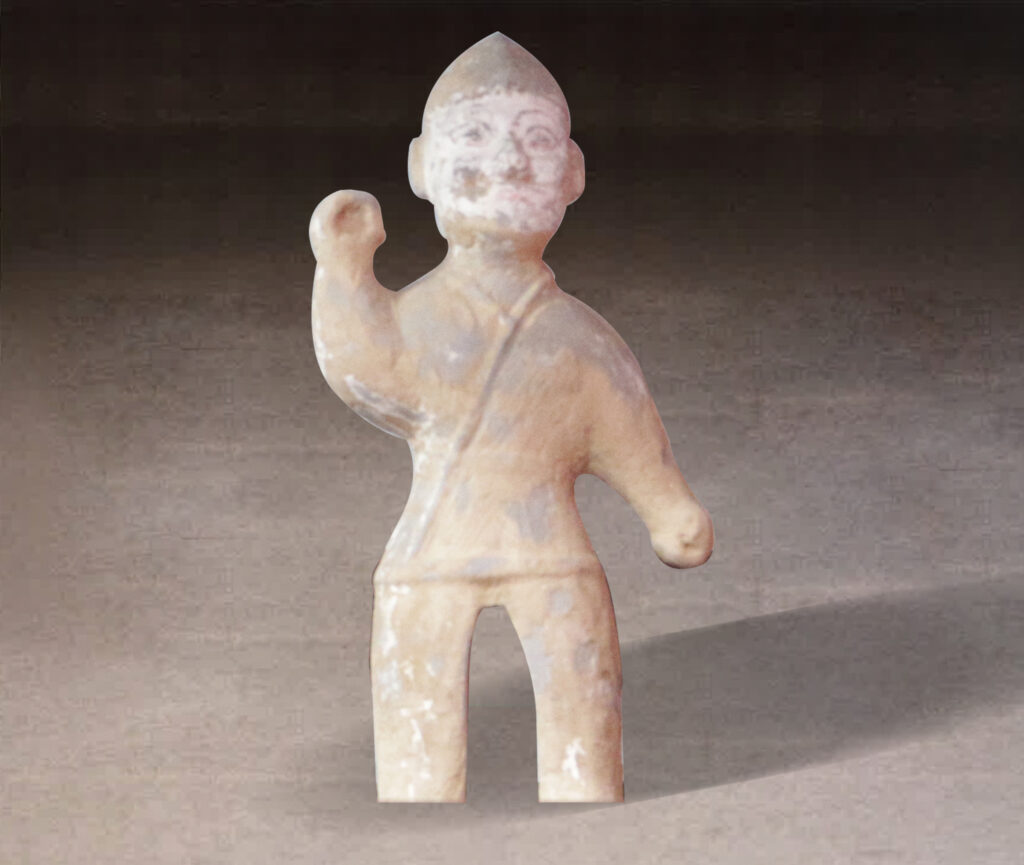
Painted Pottery Hu Groom Figurine

information

Western Jin dynasty (265–316)
Nanjing, Jiangsu

introduction

This painted pottery Hu groom figurine dates to the Western Jin dynasty and was unearthed from a Six Dynasties tomb in Nanjing. The figurine wears a pointed cap, a cross-collar short coat and trousers. Its right hand is raised as if holding reins, with traces of white pigment remaining on the face. As an attendant figurine for tomb retinue, it reflects the burial belief of treating the dead as the living. The Hu figure serves as tangible evidence of ethnic integration and Silk Road cultural exchanges during the Wei-Jin period.
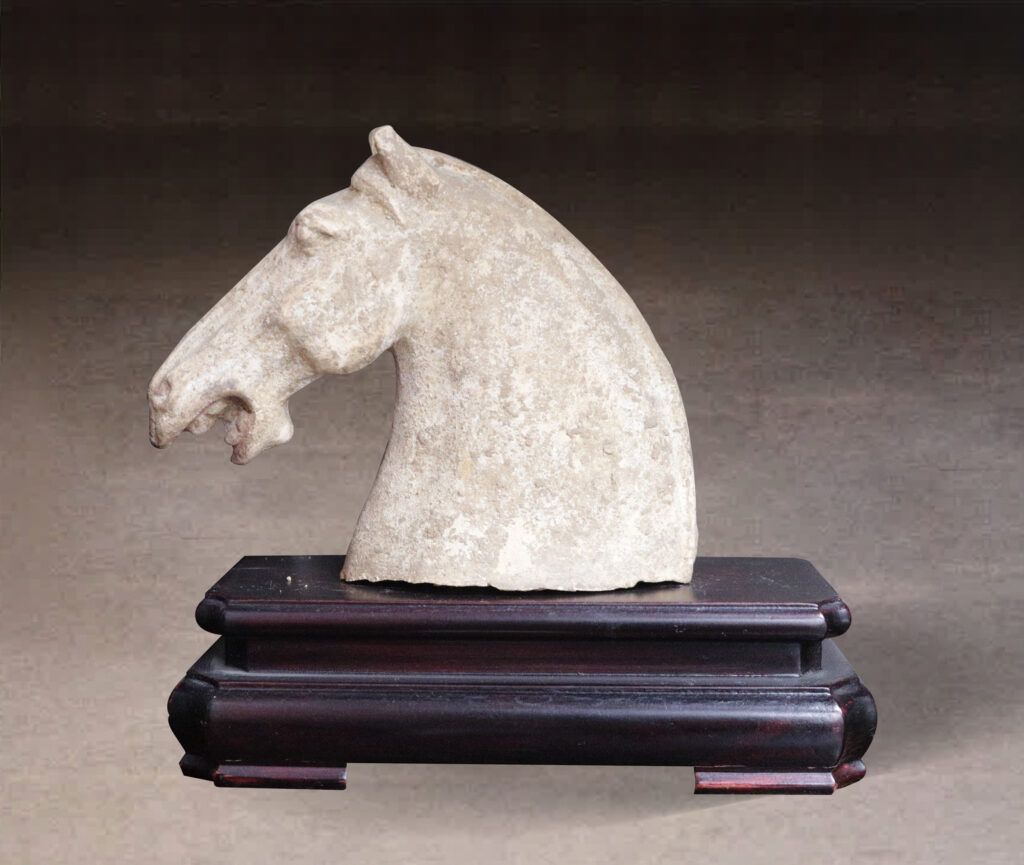
White Pottery Horse Head

information

Northern Qi dynasty (550–577)
Anyang, Henan

introduction

This white pottery horse head dates to the 6th year of the Wuping reign of the Northern Qi dynasty. It was unearthed in Anyang, Henan, and is a fragment of a funerary ceremonial pottery horse. The horse head features a vigorous outline with a slightly open muzzle. Its concise, forceful lines vividly capture the spirited bearing of a steed. As part of the tomb retinue, it was grouped with warrior and Hu groom figurines, reflecting the cavalry culture and Silk Road exchanges of the Northern Dynasties.

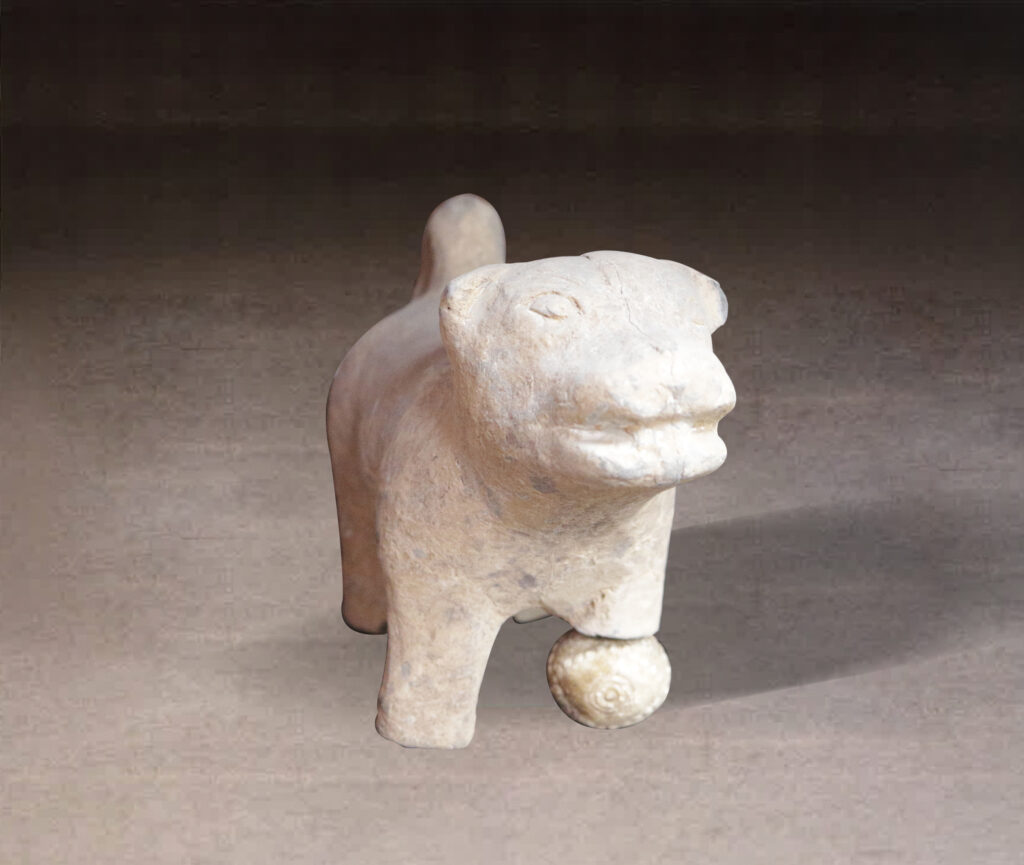
White Pottery Dog Figurine

information

Western Jin dynasty (265–316)
Nanjing, Jiangsu

introduction

Standing steadily, this pottery dog features a simple and unadorned shape with an archaic, naive sculptural style. Following the ancient belief of treating the dead as the living, the dog figurine, as a model of domestic animal, was buried in the tomb. It symbolizes guarding and accompanying its master in the afterlife and serves as tangible evidence of daily life and burial customs in the Jiangnan area during the Six Dynasties.

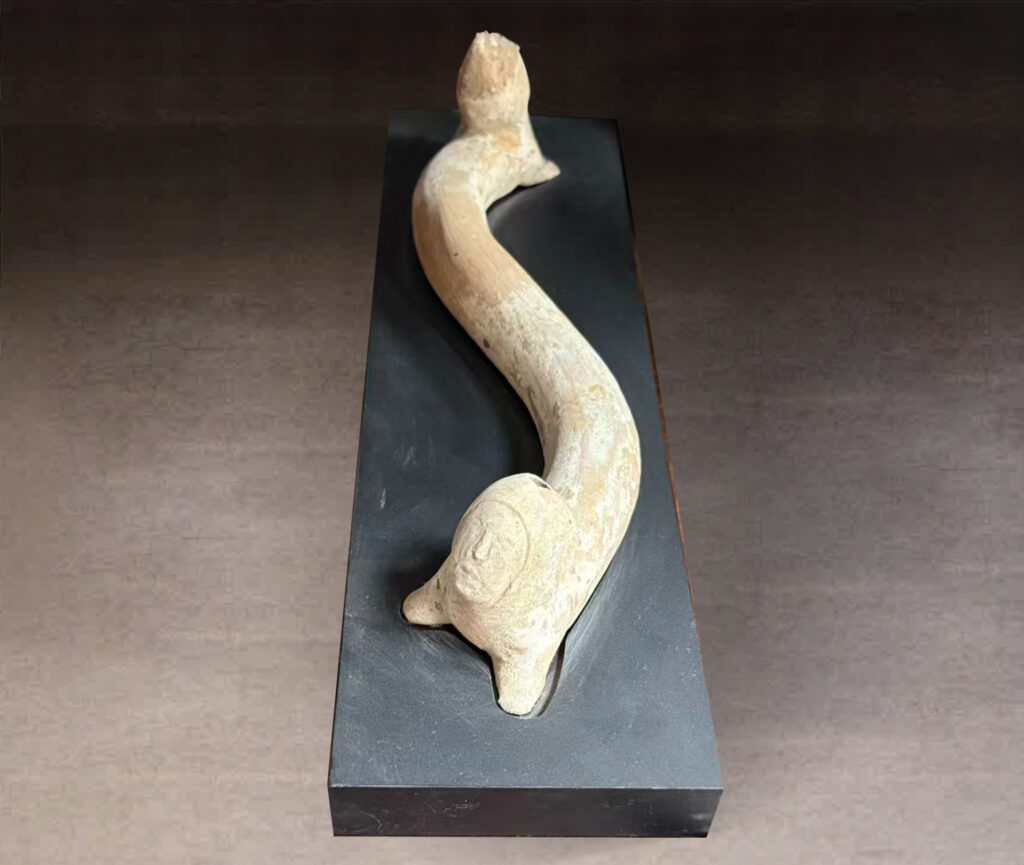
Double-Headed Human Serpent Figurine

information

Western Jin dynasty (265–316)
Nanjing, Jiangsu

introduction

This double-headed human serpent figurine is a funerary guardian artifact of the Western Jin dynasty, unearthed from a Western Jin tomb in Nanjing, Jiangsu. It features a sinuous serpent body with a human head at each end, presenting a fantastic and archaic form. Also called the Tomb Dragon in ancient burial customs, it functioned to guard the tomb, soothe the deceased’s soul and connect heaven and earth. Derived from the myth of Fuxi and Nüwa, it is distinctive physical evidence of immortality beliefs and burial rituals in the Jiangnan region.

Painted Pottery Attendant Figurines

information

Ming dynasty (1368–1644)

introduction

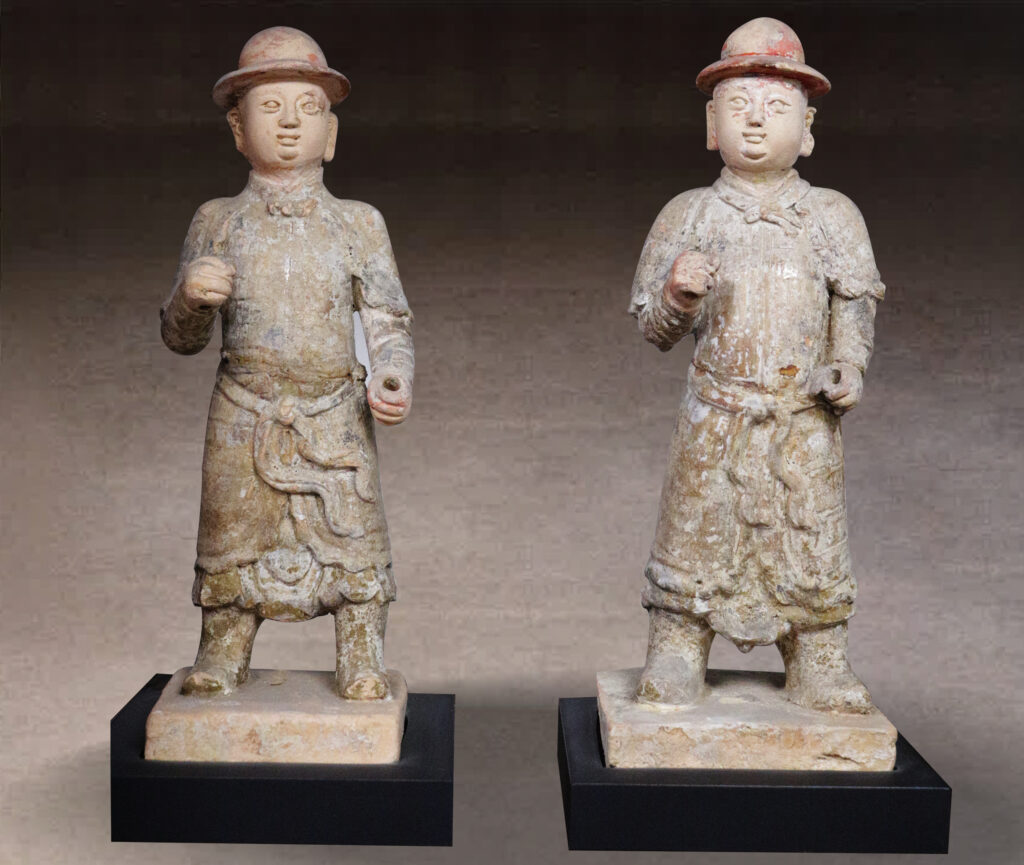
The figurines wear round dome hats, narrow-sleeved long robes and sashes, and stand on square pottery bases with traces of painted decoration remaining. Such attendant figurines were usually unearthed in sets, representing servants for the tomb occupant to attend to them in the afterlife. They serve as tangible materials for the study of Ming-dynasty costumes, pottery craftsmanship and burial customs.

Painted Pottery Maid Figurine, Western Han dynasty

information

Western Han dynasty (206 BCE–9 CE)
Xuzhou, Jiangsu

introduction

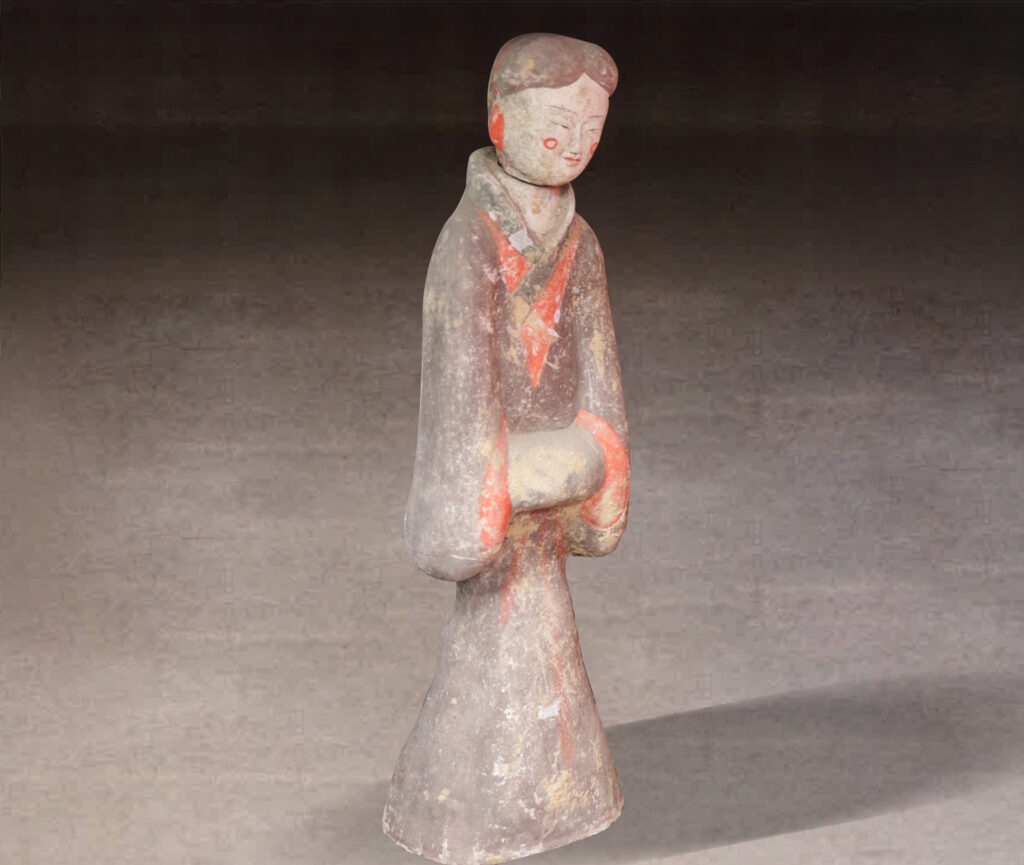
The figurine wears a Han-style coiffure with red dimples on the cheeks. Dressed in a wrap-front quju robe trimmed with red pigment, she tucks her hands inside her sleeves in a gentle and poised stance. As a burial attendant figurine, it serves as precious material for the study of Western Han women’s makeup, costumes and pottery art.

Painted Pottery Warrior Figurine with Shield, Northern Qi dynasty

information

Northern Qi dynasty (550–577)
Anyang, Henan

introduction

The figurine wears a soft helmet and armour, with both hands resting on a beast-face shield carved with a beast-head relief. Traces of red and black pigments remain on its surface. As a burial guardian figurine to protect the tomb owner, it is important material for studying Northern Dynasties armour, weapons and pottery sculpture.

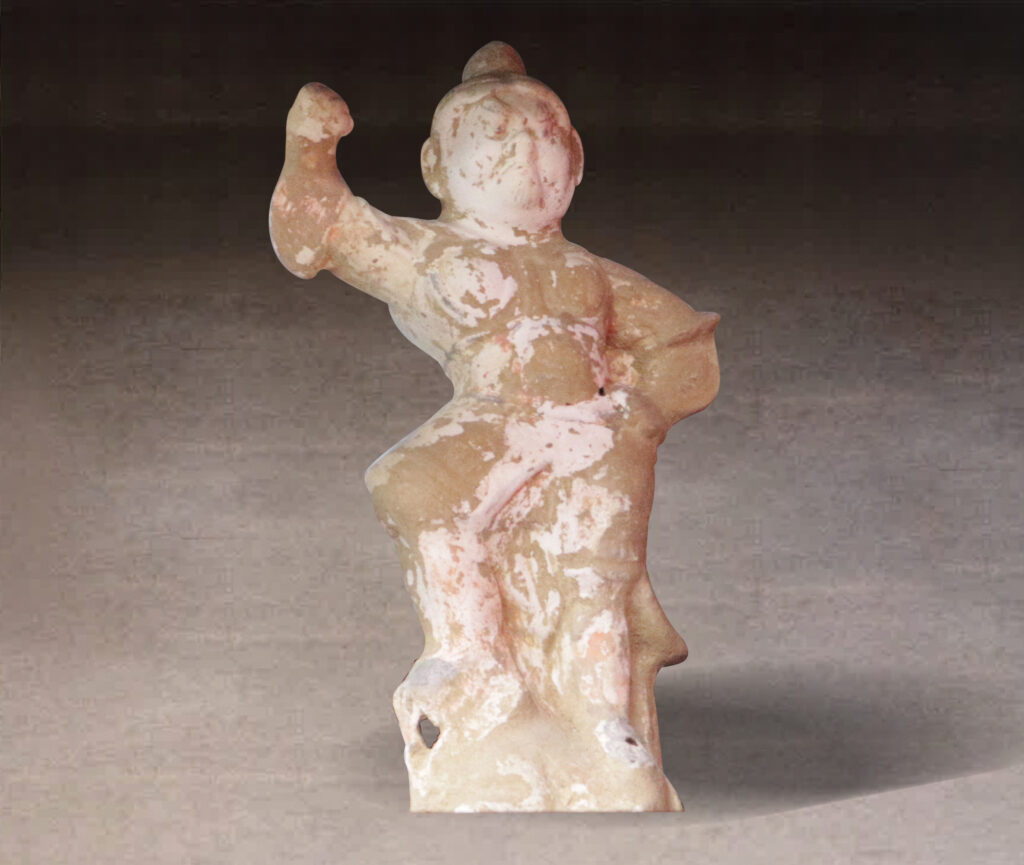
Painted Pottery Warrior Guardian Figurine, Tang dynasty

information

Tang dynasty (618–907)
Luoyang, Henan

introduction

The figurine has a topknot and well-defined muscles. One arm is raised high, with one leg stepping forward, showing powerful dynamism. Traces of white and red paint remain on its surface. As a tomb-guarding burial object to ward off evil spirits and protect the tomb owner, it is important material for studying Tang guardian figures and sculptural styles.

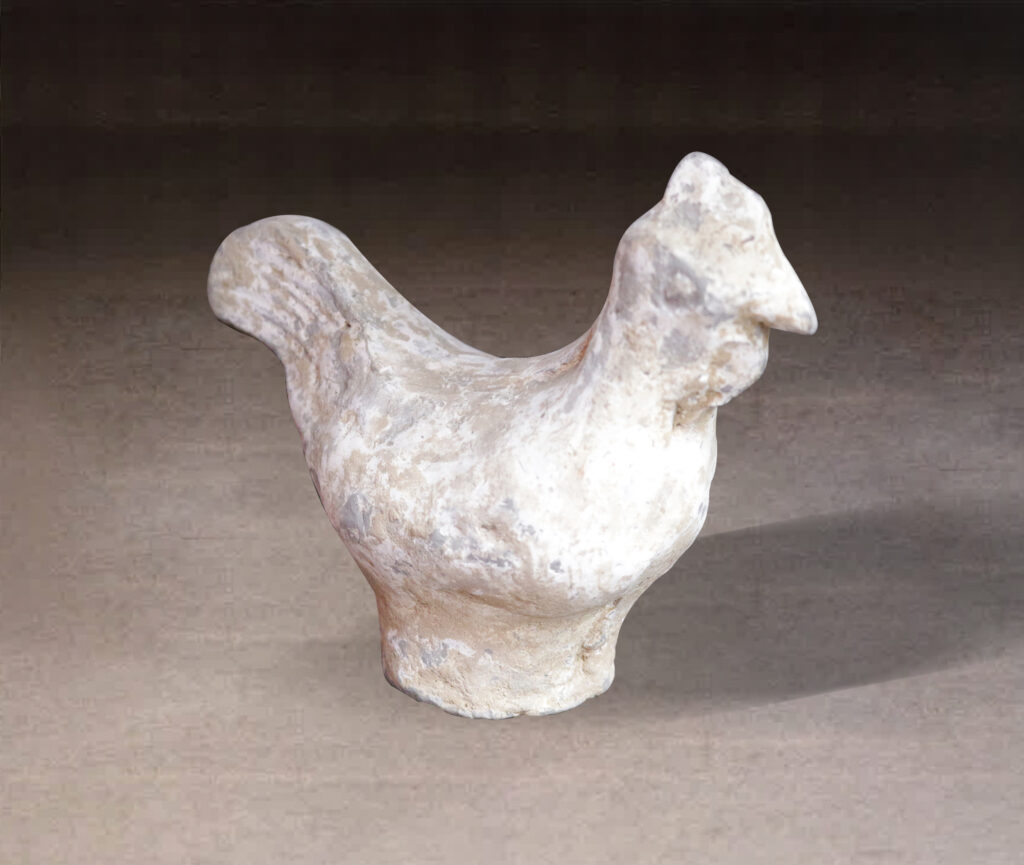
White Pottery Chicken Figurine, Tang dynasty

information

Tang dynasty (618–907)
Luoyang, Henan

introduction

Made of white pottery, it features a simple, unadorned form with distinct comb and tail. Most of its original pigment has worn away. As a burial livestock figurine, it symbolizes poultry for the tomb owner in the afterlife. It serves as physical evidence for studying Tang burial customs and folk pottery craftsmanship.

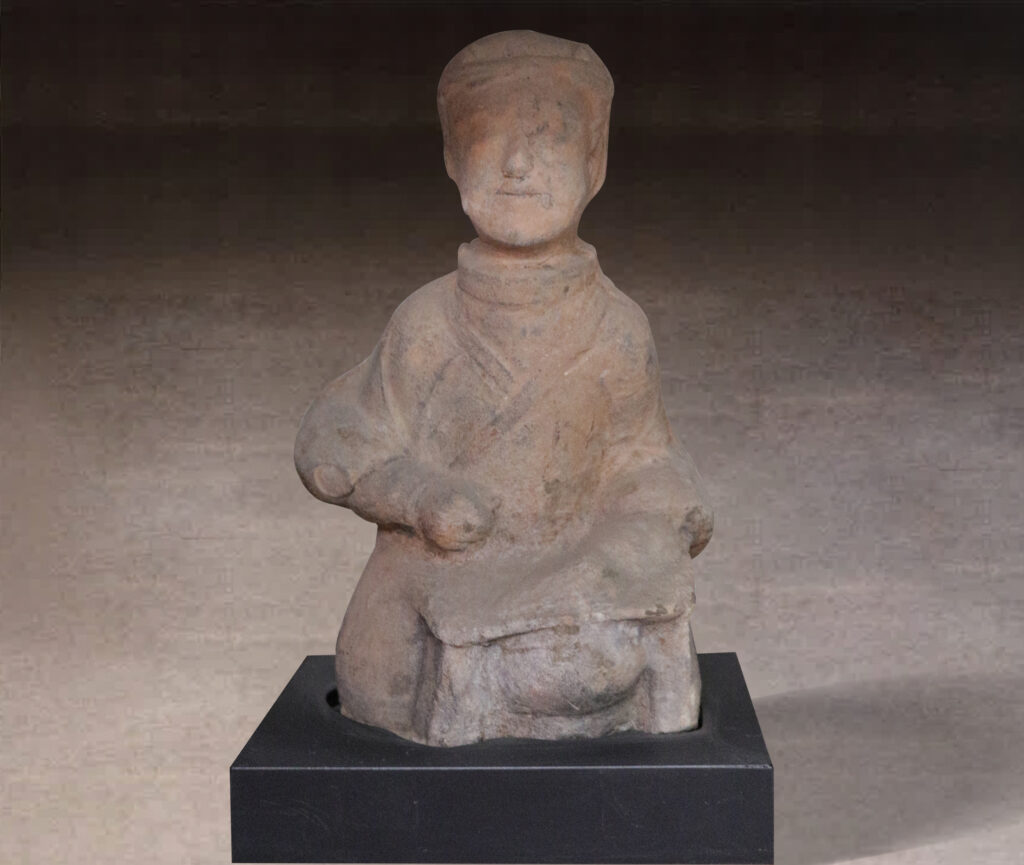
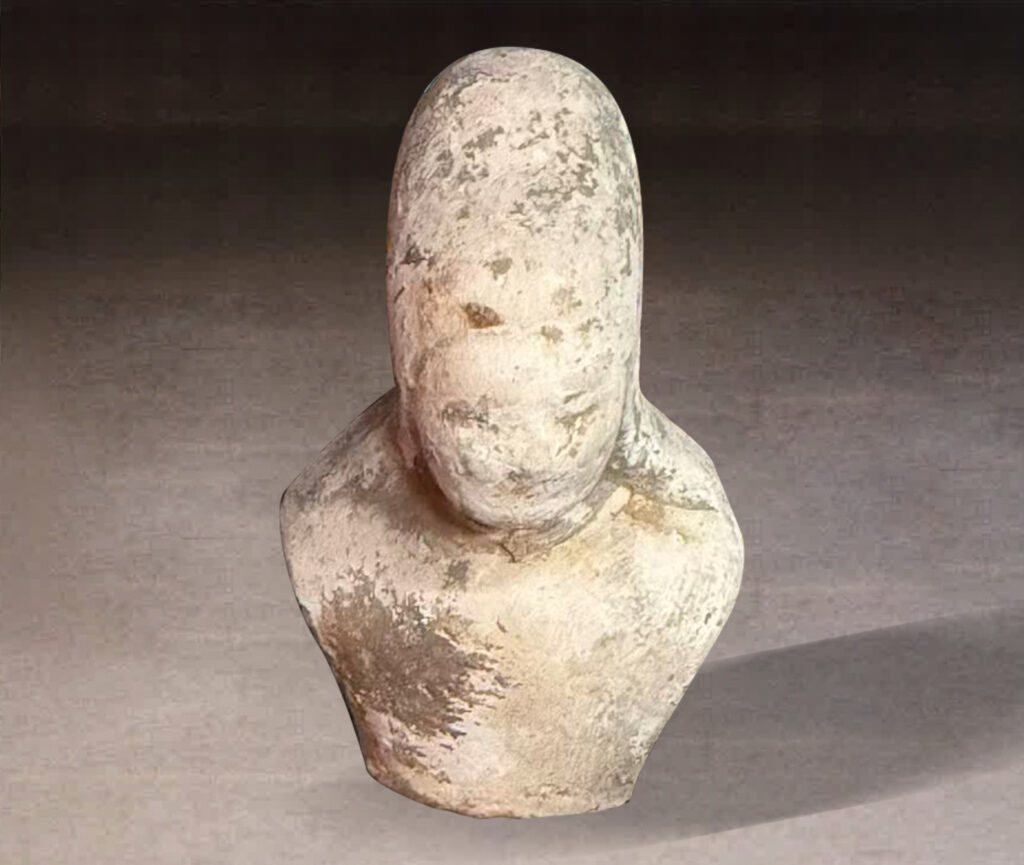
Painted Pottery Attendant Figurine, Western Han dynasty

information

Western Han dynasty (206 BCE–9 CE)
Xuzhou, Jiangsu

introduction

This is a fragmented pottery figurine, only its head and shoulders remain. It wears a hood, with the face simply modelled. The figurine is coated with white slip, and most painted decoration has flaked off. As a burial attendant figurine, it features a simple and plain form, serving as physical relics for the study of Western Han pottery craftsmanship and burial systems.